
Introduce yourself: tell us who you are in a few sentences and give us a little background on your career path thus far.
I am an Iranian-Canadian photographer, based out of Kabul, Afghanistan. I was born and partially raised in Iran, but my family and I moved to Canada while I was still a teenager. There, I was first introduced to photography in high school and the camera became an essential tool for me, a medium that enabled me to connect with my adopted home and people around me, while I struggling to learn a new language. That habit remained with me when I chose photojournalism as a career, the practice of using the camera to understand and relate to my surroundings. I left Canada in my last year of university, and landed in Afghanistan two years later with a magazine assignment in 2013. The following year, with the hopes of refining my understanding of this overly represented, yet, complex place ravaged by war, I made a bold decision and moved to Kabul at the time when everyone else was moving away.
What is your earliest memory with photography?
I was still living in Iran when my dad brought me a 35mm automatic canon camera that he had purchased in a second hand store in Japan (circa 1999). That’s when I first started photographing what was around me obsessively but every frame was precious and expensive, so I would use them carefully.
However, the first crucial and memorable turning point for me was when I worked in a darkroom for the first time in grade 11 photography class. As our very first assignment, we had made our own pinhole camera, mine was made out of a cookie box and had 9 holes on it. I still remember how magical it felt to stand over chemical trays and watch what I considered to be my masterpiece at the time, come alive. I still remember how different shades of black was appearing on my photo paper under the red light.

Describe your approach to visual storytelling?
For me a good photo essay is one that has all the elements of a good novel. It starts with either an establishing frame or one that intrigues the viewer. It has a protagonist or several of them, follows by character development. It illustrates action but also subtle quiet moments that provokes emotions. The narrative has a climax and conclusion. At the end the photo essay must leave the viewer intrigued or suspended. Something to come back to and think about, frames that will be engraved in our overly-stimulated minds and stick with the audience for days. I try to keep all of that in mind when I am developing a body of work. I make shot lists and emotion lists. I keep reviewing them throughout the journey, modifying them as needed, cross some, add some.
What is one piece of advice you would give to those just starting out or looking to improve their visual storytelling skills?
Find a subject that you’re curious to explore and keen to learn about. It doesn’t have to be far from home, it could be in your backyard. Actually those stories which naturally come with better access, are a great starting point. Look at a lot of good photography and JUST good photography so you can develop a fine visual vocabulary and taste. This will help you to see and recognize good lighting, dynamic arrangements and basically all the elements that make a good single photograph, when out in the field. Then with time, comes the art of sequencing them and the ability in telling a story through those single photographs. Show your work to people that you consider mentors or those you look up to. Receive feedback and criticism with open arm and open mind, because that’s how you’re able to learn more and be a better visual storyteller. All these can help you find your voice and aura.

How did this particular project/body of work come about? Why were you interested in it?
When the Coronavirus outbreak became a global phenomenon, my editor at the New York Times Magazine reached out to me and asked if I had any plans of covering the pandemic from where I was, which was Kabul, Afghanistan. She also specifically asked if I was willing to go to Iran and cover the outbreak there, at the time when Iran had become the second largest epicenter after China. This was around mid-march.
I said yes and proposed an elaborative trip starting from Tehran going east, crossing the border into Afghanistan and ending the story in Herat which I foresaw to be the epicenter of the outbreak in Afghanistan. However my press credential for Iran did not arrive on time because of the Persian new year, so I proposed to go to Islam Qala border and start the journey there, on the border of Iran and Afghanistan. We were ahead of the curve covering the mass return of illegal Afghan migrants. It was nothing like I had ever seen. I had been to Islam Qala border numerous times and had documented returnees before but I have never ever stood over such scene. On that day alone, 11,627 people crossed the Iranian border into the Afghan province of Herat. A sea of young men formed outside an immigration center that could accommodate only 300 people at a time. Some carried backpacks, others large sacks overstuffed with their belongings. One carried a child’s bicycle, another a string instrument. One had just two blankets folded under his arm, another a canary in a cage. As the line slowly moved forward, some put down shawls to pray; others found rocks to rest on.
How does this moment impact how you view both yourself as a visual storyteller and your project?
At the time and age where movement have become more restricted, first world countries and the West have become focused on their own, and only their own, problems, I am realizing how crucial and important it is to be present in places such as Afghanistan, to bear witness, reflect on it and share it with the world.

What has been a specific surprise or challenge of working on this project?
COVID-19 is fast changing story and for this specific assignment, we caught it at its early days. Too many uncertainty and misleading facts in the backdrop of ongoing war, made the execution of this project much more difficult. Working in Afghanistan requires constant risk assessment and with the virus, the amount of risk assessment we had to do for every move was double, if not more.
Pick 2-3 photos from your series to deconstruct: what was happening when you took the shot? Set the scene, what was going through your head?

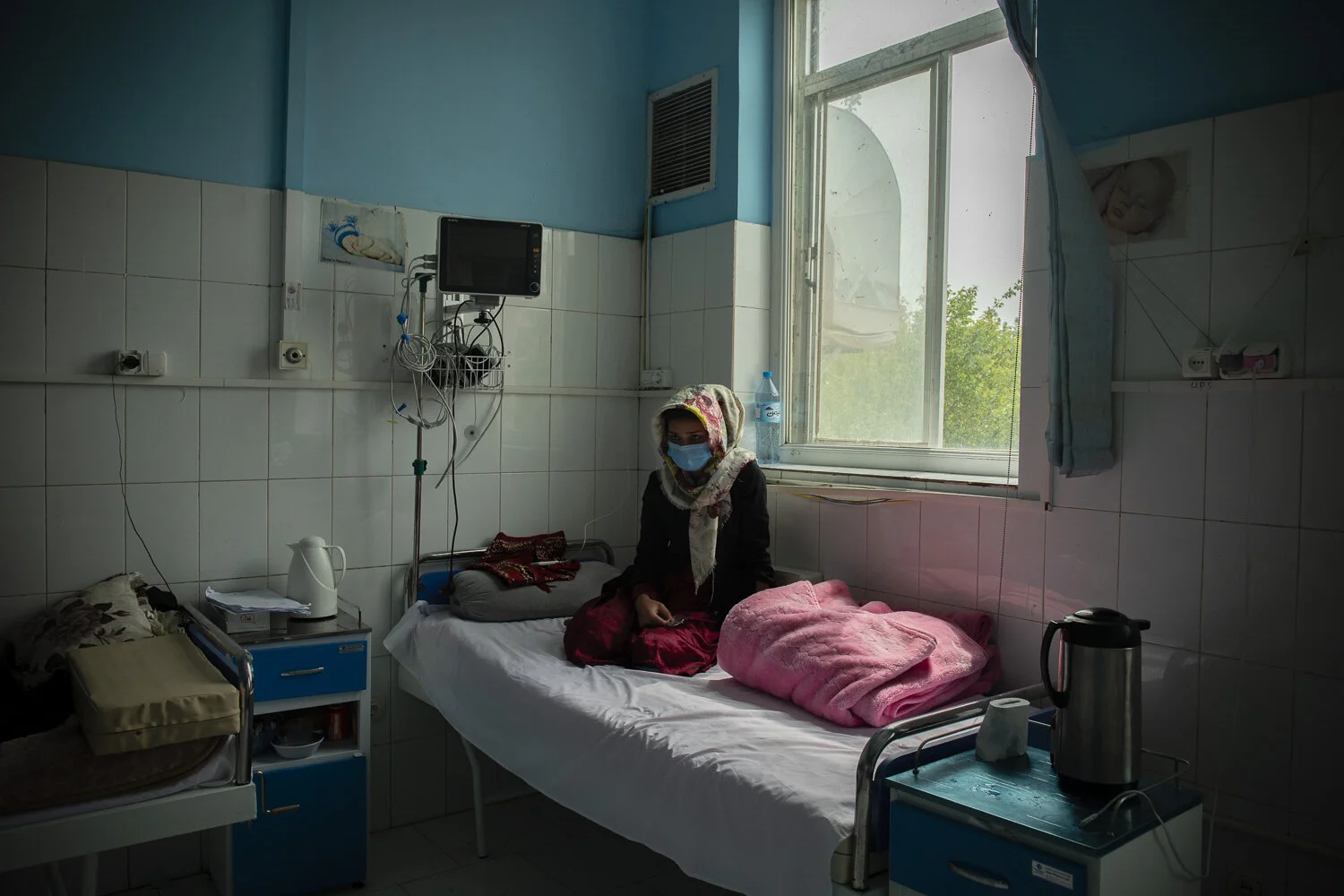
The opening photo of the young girl sitting on the bed inside the hospital was a frame that I shot blindly. Entering the covid-positive ward of Herat hospital, I was wearing mask, gloves, surgical gown and goggles. Half way through my short visit, my goggle was so foggy that my sight was blurry. I was talking to a different patient when I turned around and saw a dreamy, hazy beautiful frame with a figure sitting on the bed. The light and her red skirt caught my eyes and I snapped a photo blindly. Just one frame.

Similar thing happened with the photo of the gun resting in between hospital beds that was being used as a make-and-shift resting place for the unit that was guarding the hospital. When I took the frame, my eyes were on the gun, the hospital bed and the bright pink blankets. Only after I downloaded the photos on my laptop and was going through them that I started seeing all the little details around the window frames that only elevated the value of the picture: a uniform hanging from the curtain rod, a flack jacket resting on the bed, a box of surgical gloves, a mask hung from the window, a packet of cigarettes and plants resting on the window frame, in such a masculine macho environment among soldiers. This is Afghanistan’s Next War.
What motivates you to keep making pictures? In one sentence describe why visual storytelling matters to you.
Visual storytelling matters because as much as they have been used to deprive and to disparage, they are also used to empower and to humanize. That is the power of visual storytelling.
***
Kiana’s work was selected as part of our Artists Against an #Infodemic campaign — a project by CatchLight, Dysturb and The Everyday Projects made possible thanks to the support from the John S. Knight Journalism Fellowships program at Stanford University and PhotoWings.
The project draws on images by photographers, muralists, street artists, and illustrators from around the world to bring greater attention to public health messages. Working with memetic distribution expert Pamela Chen, and Dr. Jenell Stewart, DO, MPH, an Infectious Diseases specialist, the collaboration utilizes the power of visuals to contest misinformation and disinformation in communities where infection rates are most prominent, and to improve public communication and news delivery surrounding COVID-19 to underserved communities.
