
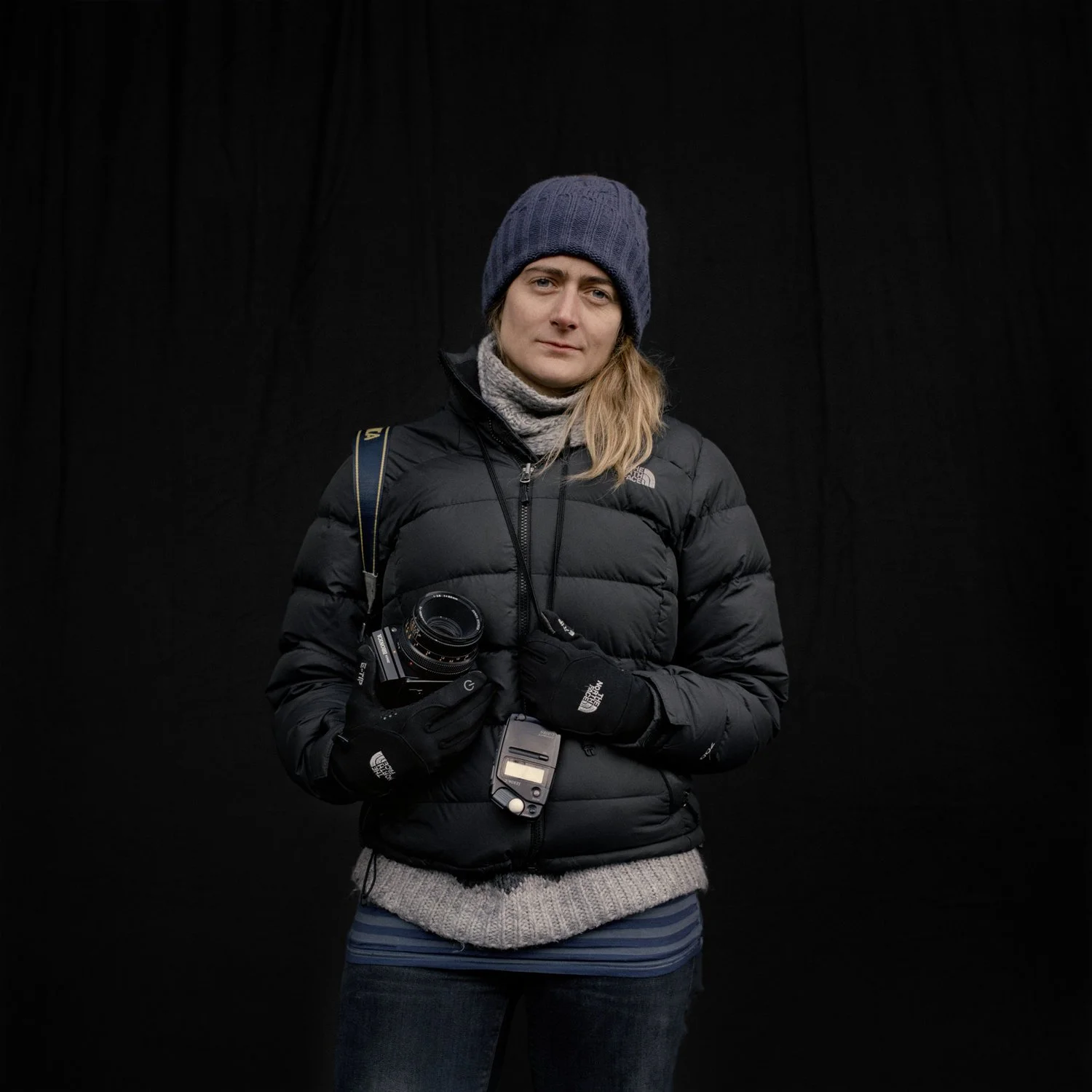
Anastasia Taylor-Lind is an award-winning English/Swedish photojournalist, highly regarded for her work covering issues relating to women, population and war.
She believes traditional photojournalism and war reporting reduces real people to characters in international war stories: combatants, soldiers, separatists, rebels, terrorists, protesters, refugees, collateral damage, civilian casualties. Because CatchLight believes that Taylor-Lind’s years long perspective in the region is worth sharing at this historic moment, we caught up with her recently as she made her journey from Poland to Lviv. Below is her interview:

This is the second time Lidiya Ivanenko, holding her son, Myron, has fled. The first was in 2014 when conflict with Russian-backed separatists broke out near her home city of Luhansk, in eastern Ukraine. “After we moved to the Kyiv region, I did not think this war would catch up with me.” Anastasia Taylor-Lind, Alice Aedy and a team from National Geographic set up a makeshift portrait studio outside a high school sports hall in Przemyśl, a Polish town close to Ukraine’s border. For most of those we interviewed, this was the first refuge point after crossing the border—where they can sleep, eat, and make plans about where they’ll go next.
©Anastasia Taylor-Lind for National Geographic
Ludmyla Kuchebko, 72, from Zhytomyr has left the air-raid sirens behind but worries for her son in Kyiv. Looking to God to “save not only my son, but Ukraine,” she prays for every passenger on every train. “Today we pray not only for Ukraine—we pray for Russia, for our brothers and sisters there.” Alice Aedy and Anastasia Taylor-Lind with their team from National Geographic spent last week making photographs and recording the stories of people fleeing the Russian invasion of Ukraine. ©Anastasia Taylor-Lind for National Geographic 
Amoakohene Ababio Williams, 26, originally from Ghana, says he was forcibly separated from his Ukrainian wife, Sattennik Airapetryan, 27, and their one-year-old son, Kyle Richard, along with other Black men, just before reaching the Polish border after fleeing Odesa. “I was thinking, that’s all. Maybe I will not see her again.” He made it. Anastasia Taylor-Lind and Alice Aedy spent last week making photographs and recording the stories of people fleeing the Russian invasion of Ukraine. ©Anastasia Taylor-Lind for National Geographic 
A sleepless Oksana Hapbarova (left), 18, says she and her mother, also Oksana, 39, tried to wait out the Russian attacks in a Kyiv bomb shelter. But it was little comfort, says the younger Oksana. “For six days in the shelter, I couldn’t sleep—because I was scared I would never wake up,” she says. ©Anastasia Taylor-Lind for National Geographic
What drew you to Ukraine for your previous work there?
The first time I worked in Ukraine was in Crimea in 2010. In 2014 I was photographing a project about European countries with declining populations and travelled through Kyiv during the Euromaidan revolution, I decided to stay in the capital for a month documenting the revolution, in part, making portraits in a make-shift portrait studio I set up inside the barricades on Hrushevkhovo Street. This work was published as a monograph by GOST books the same year. I began documenting the way ordinary people’s lives are impacted by the war, and the ways they adapt to live under these extraordinary circumstances, in the eastern Donbas region of Ukraine in 2014, reporting together with Alisa Sopova, a writer from Donetsk city, for the last 8 years.
Why is it so important for you to go back, now, to document what is happening?
I’ve been working in Ukraine for 8 years. I feel I have to be here now. I was assigned by National Geographic Magazine to create a series of photographs, in my make-shift portrait studio, of people fleeing the Russian invasion of Ukraine. Together with film-maker Alice Aedy, I spent 5 days in Przemysl (a Polish town close to the Ukrainian border) making video interviews and photographing some of the, now 2 million, people who have fled Ukraine. Our National Geographic team set up the makeshift portrait studio outside a high-school sports hall used to temporarily house refugees. For most of the people we interviewed, this was the first refuge point after crossing the border, where they could sleep, eat and make plans about where they will go next.

What do you wish people to know about the situation there?
I’m glad that the Russian invasion is being extensively documented by both Ukrainian and international journalists. The war here started in 2014 and international media coverage declined over the years while the war dragged on in the east of the country. I believe it’s important to record the devastating events taking place today.
When did you enter Ukraine? How long do you plan to stay? Where should our readers be looking for your most recent work?
After working in Poland for a week for National Geographic, I crossed the border and travelled to Lviv 3 days ago. Who knows how long the war will go on for, or how long I will stay. My work from Lviv, for Die Zeit newspaper in Germany, was published on March 10.
Is there anything else you’d like to share about your experience so far?
What else is there to say, I am at a loss for words.