For a decade, 2024 CatchLight Global Fellow Anastasia Taylor-Lind has documented civilian experiences of war in the eastern Ukrainian region of Donbas.
Her project, “5K from the Frontline ,” bridges visual representations and intimate reporting of local communities in collaboration with Ukrainian journalist and anthropologist Alisa Sopova—everyday life and the practices of resilience; the material culture of war, from emergency suitcases to leftover pieces of munition turned into art; the changed relationship of people and the natural world; how civilians navigate an environment that once was familiar and domestic, and now is deadly.
With respect and tenderness, Taylor-Lind illustrates the humanity of a people, not as pitiful victims of war but as individuals with agency and lives beyond tragedy.
A ruined apartment building in the town of Lyman, in late 2022. The first year of the full-scale Russian invasion tested not only Ukraine’s will to live and resist but also some of the ideas about war that we take for granted. One of these ideas is resilience. As Ukrainians’ resilience is increasingly becoming a media trope, it might be a good time to ask, as some social scholars do, whether resilience is something to be celebrated. The problem with resilience is that it’s not a choice. People are forced to practice it when they have no other option but to survive under impossible conditions. Perhaps, instead of admiring the resilience of Ukrainians or other suffering communities, we should ask why they suffer and how we can help them end that suffering instead of learning to live with it.
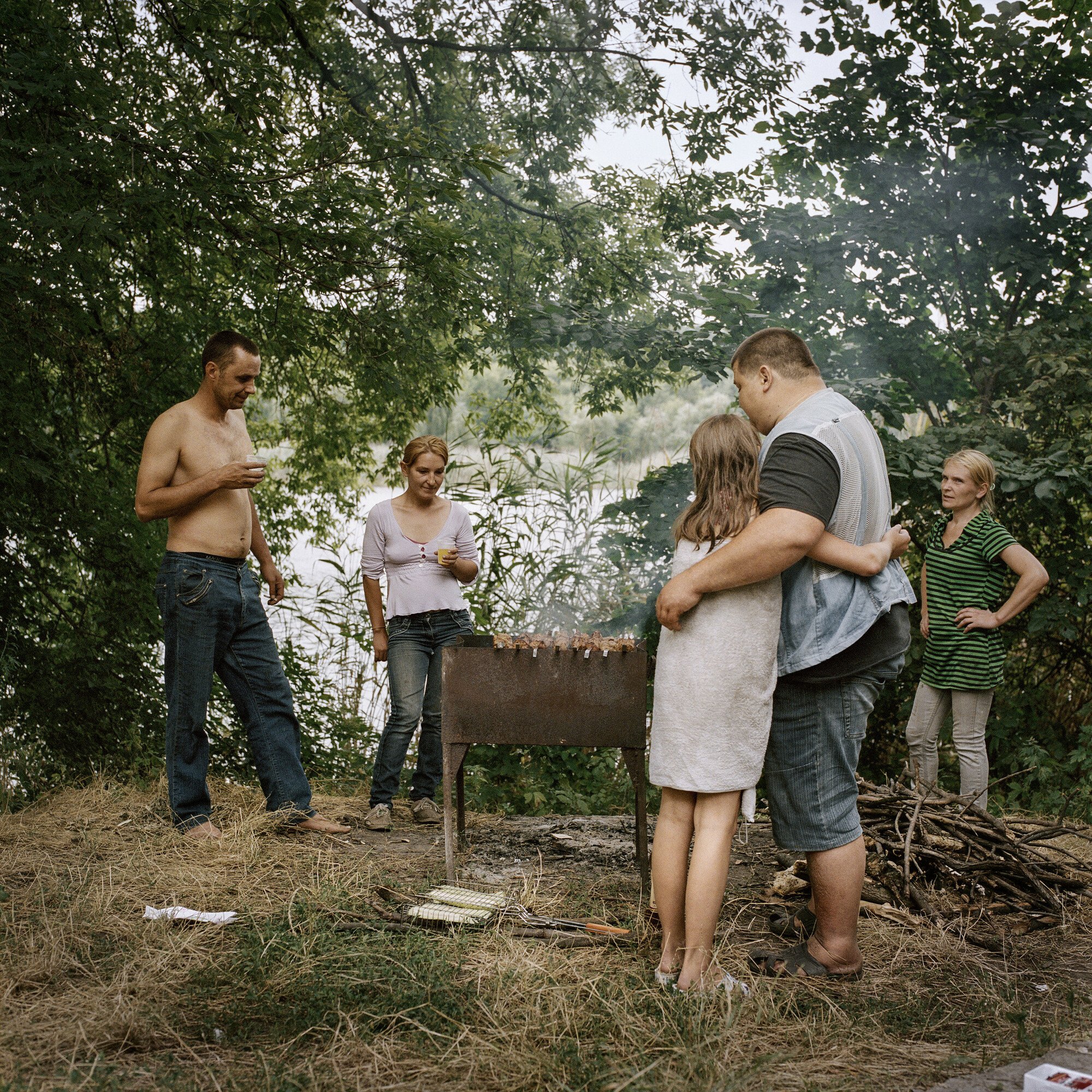
Another such idea is peace. We all, with a few deplorable exceptions, agree it is right to choose peace over war. However, some of us are not in a position to choose. Pacifism is not only an admirable moral stance, it is also a privilege. To advocate for peace over war, you have to be in the position of the aggressor, for only the aggressor has a choice between the two. When you are a victim, your choices boil down to surrendering, living under occupation, or being murdered. Another option is resistance, the one Ukraine opts for. But where does it fit in the war/peace binary? And when we call on Ukrainians to choose peace, what exactly are we suggesting they should choose? Surrender? Occupation? Death?These are some of the uneasy questions that linger as the war in Ukraine is approaching 10 years with no end in sight. Donbas, December 2022. 5K from the Frontline – Donbas, Ukraine. © Anastasia Taylor-Lind / Alisa Sopova / CatchLight Global Dolyna village, which was raised to the ground after sitting on the frontline between Ukrainian and Russian forces for months in 2022. Donbas, December 2022. 5K from the Frontline – Donbas, Ukraine. © Anastasia Taylor-Lind / Alisa Sopova / CatchLight Global A bus departing from Kurakhovo, a frontline town, to the entry checkpoint into the occupied part of Donetsk region in 2019. After reaching the checkpoint, passengers had to queue for many hours, in the middle of a mine field, waiting to cross. Despite harsh conditions, over a million people crossed this line every month until it was closed in March 2020. One of the main reasons for traveling to visit family members on the other side. 5K from the Frontline – Donbas, Ukraine. © Anastasia Taylor-Lind / Alisa Sopova / CatchLight Global Ukrainian soldiers build defensive structures in the countryside near Sloviansk in June 2022. Such activities help Ukraine defend its territories and populations. They also transform the country’s landscape into the landscape of war. War and peace are two competing modes of society, and of the natural and built environment. Infrastructures are built for peacetime but are taken over, relabeled, and used differently during war. For us, it is our home, our corner store, or our cherry tree planted by our grandfather. In military instructions, these are merely elements of a landscape that can be used as a firing point, cover, camouflage, or roadblock. The violence of war takes place on many levels, and the transformation of the environment from lived to deadly, from familiar to hostile, from the landscape of childhood memories to the landscape of trauma, is very painful yet rarely spoken of. 5K from the Frontline – Donbas, Ukraine. © Anastasia Taylor-Lind / Alisa Sopova / CatchLight Global Anna Dedova at the grave of her son, who accidentally killed himself when he opened a hand grenade he found near his home in the village of Opytne. This visit was a rare opportunity: The graveyard was mined and civilians were not usually allowed to enter it. Opytne, a suburb of Donetsk city, was stranded in the gray zone for eight years. For a while, locals who died or were killed by shelling were buried in their backyards. Later, the Ukrainian soldiers stationed nearby would volunteer to take the dead to the graveyard. A coffin would be placed in a military truck and relatives would make their goodbyes, hoping they’d be able to find the graves later. In 2019, local activists managed to organize a visit for relatives to the Opytne cemetery for the first time in five years. They secured a relatively safe path toward the graves, but the cemetery had become so overgrown that people struggled to find the crosses and gravestones that marked the burials. Relatives hurried to cut the grass and re-establish the basic order of the cemetery in the time they had, unsure of when they would have the chance to pay their respects again. In 2022, Opytne was occupied by Russian forces. 5K from the Frontline – Donbas, Ukraine. © Anastasia Taylor-Lind / Alisa Sopova / CatchLight Global Tatiana Batskalyova cares for her 90-year old mother-in-law, Lira in 2019. Both women fled their house in Opytne, in the gray zone between Avdiivka and Donetsk, which was destroyed by shelling. In 2019, they live in an apartment in Avdiivka that was also heavily damaged by shelling and then renovated by the family. Tatiana had been unsuccessful in receiving compensation for the war-damage from the state. By the 2022 Russian invasion of Ukraine Lira had died and Tatiana was forced to flee again. 5K from the Frontline – Donbas, Ukraine. © Anastasia Taylor-Lind / Alisa Sopova / CatchLight GlobalTest Label © Anastasia Taylor-Lind / CatchLight Global Fellow Elena Lebedeva has her shrapnel wounds dressed at a hospital in Pokrovsk. Elena is an activist from the village of Opytne. Together with her husband, Rodion, she supported about 30 elderly neighbors who were stranded in the gray zone between 2014 and 2022. People in Opytne had no access to electricity, running water, heating, groceries, healthcare, and other essential services during this time. Only a mud road running through a minefield connected them to the outside world, and they relied on Elena and Rodion for their survival. Fighting around Opytne intensified with the full-scale Russian invasion. In June 2022, Elena was injured by shelling in her backyard and evacuated to Pokrovsk. When this photograph was taken, the couple faced a moral dilemma. Returning to Opytne would be akin to suicide. However, they were reluctant to abandon the vulnerable and elderly who relied on them. Eventually, Elena and Rodion relocated west to the Dnipro region, where they continued their humanitarian work. Everyone else in Opytne either fled, died, or went missing. Donbas, June 2022. 5K from the Frontline – Donbas, Ukraine. © Anastasia Taylor-Lind / Alisa Sopova / CatchLight Global Avdiivka suffered from the war’s consequences long before the full-scale Russian invasion. In 2019, the town struggled with a shortage of medical staff as doctors and nurses began moving away from this frontline area. The only gynecologist remaining was unable to keep the local hospital’s maternity department running. The department was closed after a woman and her baby, died in labor in 2019. From then on, women in labor had to travel 80 kilometers to a hospital in another town. All major roads in and out of Avdiivka were inaccessible due to the war, so the locals used a dirt road through a field. This road was in such bad disrepair that people compared the experience of traveling it to riding a washboard. Irina Linnik, pictured here, said she was having nightmares throughout her third trimester, worrying that something would go wrong on this long journey. To add to her worries, she had to travel alone because the family could not afford the trip for her and her husband. 5K from the Frontline – Donbas, Ukraine. © Anastasia Taylor-Lind / Alisa Sopova / CatchLight Global A polling station for parliamentary elections in Marinka. 5K from the Frontline – Donbas, Ukraine. © Anastasia Taylor-Lind / Alisa Sopova / CatchLight Global The Grinik family at a picnic in Avdiivka in the summer of 2019. The Griniks resided in a suburban neighborhood called “old Avdiivka,” which was very close to the frontline. “Everything is ok, except our neighbors are a bit noisy.” This is how they used to joke about the fact that the nearest Ukrainian military position was only 50 meters from their house. Between 2014 and 2022, life in Donbas was hard and full of dangers, yet many local people, like the Griniks, chose it over the insecurity and indignity of displacement. After the full-scale Russian invasion began, they had no choice but to leave. The Griniks fled Avdiivka in the spring of 2022 after several shells landed in their garden. Their family home has now been destroyed. 5K from the Frontline – Donbas, Ukraine. © Anastasia Taylor-Lind / Alisa Sopova / CatchLight Global A medic from Pirogov First Volunteer Mobile Hospital whose nom de guerre is Van Damme (after the Hollywood actor) at a base in Sloviansk. The NGO treats and evacuates injured soldiers and civilians from the combat zone to hospitals further back from the frontline. Donbas, June 2022.
5K from the Frontline – Donbas, Ukraine. © Anastasia Taylor-Lind / Alisa Sopova / CatchLight Global People congregating near a government office in downtown Marinka, where residents come to seek humanitarian aid. 5K from the Frontline – Donbas, Ukraine. © Anastasia Taylor-Lind / Alisa Sopova / CatchLight Global Nikolay Grinik fishing with his children, Kirill and Miroslava, at a lake in Avdiivka in the summer of 2019. Nikolay and his wife, Olga, lived very close to the frontline on the edge of Avdiivka. Both their children were born after the war began. The couple used to joke about it. “In 2014, we were sitting without electricity for three months because of fighting. Nine months later, our daughter Miroslava was born. In 2016, we had no light for a month and nine months later, we got our son Kirill. How else are you gonna entertain yourself in the darkness? Now we pray there is no electricity outage again,” said Nikolay. In 2022, Nikolay volunteered to join the Armed Forces of Ukraine. Olga and the children fled to central Ukraine. 5K from the Frontline – Donbas, Ukraine. © Anastasia Taylor-Lind / Alisa Sopova / CatchLight Global Home-grown vegetables and pickles at the Grinik family’s picnic near Avdiivka. Donbas, July 2019. 5K from the Frontline – Donbas, Ukraine. © Anastasia Taylor-Lind / Alisa Sopova / CatchLight Global Three-year old Kirill Grinik at his family’s house in 2019, which was situated 50 meters away from a Ukrainian military position. He was born during the war and has never seen his native town of Avdiivka at peace.In 2022 the family fled to Poltava region to escape the war. This house has been destroyed, along with much of the Avdiivka, which was occupied by Russian forces in 2024. 5K from the Frontline – Donbas, Ukraine. © Anastasia Taylor-Lind / Alisa Sopova / CatchLight Global Until February 2022, Elena Dyachkova and Aleksander Dokalenko lived a few hundred meters away from the frontline in Avdiivka. Their house got hit several times but the couple remained there because they feared displacement would be even worse. Last spring, the family had no choice but to flee for their lives. Their experience of displacement has proven their fear right. Early on, Elena crossed into Poland together with her daughter, Yulia, and her two-year-old grandson, Nikita. Aleksander stayed behind, as Ukraine restricts men between the ages of 18 and 60 from leaving the country. He ended up in a shelter for the internally displaced. In Poland, the women soon ran into financial hardship. Before the invasion, Yulia worked as an auditor. In Poland, however, she could only find a job planting trees in a local forestry. Elena tried her luck at a fish processing factory. The physically demanding jobs were not enough to make ends meet. Soon Yulia returned to Kyiv, to her old job. This allowed her to send money to Elena and Nikita. Yulia was separated from her son, while Elena’s relationship with Aleksander grew increasingly strained with no prospect of reunification in sight. This photo is of Elena and Nikita in their temporary home in Poland. Several months after it was made, they returned to Ukraine. Theirs is a typical trajectory. Even though European countries have offered an unusual degree of hospitality, for most Ukrainians, it is not enough to build a new life. Many Ukrainians abroad struggle financially, find it hard to integrate into host societies and, most importantly, suffer from being separated from their loved ones. Displaced women and children are mostly on their own and families face the prospect of being split indefinitely. Poland, December 2022. 5K from the Frontline – Donbas, Ukraine. © Anastasia Taylor-Lind / Alisa Sopova / CatchLight Global “I can describe it all with one word: painful,” says Aleksander Dokalenko as he greets us in his room in a shelter for displaced people in the Dnipro region, about 200 kilometers from his home. We’ve known Aleksander, his wife Elena Dyachkova, and their German shepherd, Lord, since 2018. Until the spring of 2022, they lived in Avdiivka. As their neighborhood turned into an active battlefield in the months following the full-scale Russian invasion, Elena fled for Poland, where she joined her daughter and little grandson as refugees. Aleksander stayed longer. In his last weeks in Avdiivka, he lived in a basement and worked in a municipal company distributing water to residents after the town’s water system was destroyed. “I lived only 500 meters away from work, but it took me forever to get there every morning,” he recalls. “You begin walking, then hear a whistle in the air and run for cover into the nearest building. You stand there and wait to hear an explosion; this means it has landed elsewhere. So you continue walking, but only until the next whistle.” The water facility where Aleksander worked was targeted nearly every day. As a result of constant stress, he began having heart issues and eventually decided to leave. Now, he is in relative safety but badly misses home, Elena, and Lord, who was left behind with neighbors. He showed us a smartphone video on repeat from his birthday party filmed shortly before the invasion, the last record of the family being happy and together. Several months after this photo was made, Elena returned from Poland to join Aleksander, choosing family reunification over safety. Like so many displaced Ukrainians, they are struggling to decide what to do next and how to rebuild their shattered lives. Donbas, December 2022. 5K from the Frontline – Donbas, Ukraine. © Anastasia Taylor-Lind / Alisa Sopova / CatchLight Global Residents wait for hot food distribution from World Central Kitchen in Lyman, which was occupied by Russian forces and liberated in the Ukrainian Eastern Counteroffensive on 2nd October 2022. Donbas, December 2022. 5K from the Frontline – Donbas, Ukraine. © Anastasia Taylor-Lind / Alisa Sopova / CatchLight Global Miroslava Grinik pulls her little brother Kirill on a sled while their mum Olga puts on his mittens, Avdiivka, 2021. Like everyone in Avdiivka, the Griniks had gotten used to this “new normal” way of life by 2021 – not only after one year of COVID-19 but also after seven years of war. Their house, only 50 meters from a Ukrainian army position, was decorated for the New Year and the children played with the toys they’ve gotten as holiday gifts. Inside their living room, everything looked completely peaceful. At the same time, the sound of shelling could still be heard from time to time on the outskirts of the town. Less obvious yet devastating consequences of the conflict also took their toll on the lives of people in Avdiivka – disrupted infrastructure, lack of access to medical services and limited employment opportunities. However, life went on, despite all the disruptions. 5K from the Frontline – Donbas, Ukraine. © Anastasia Taylor-Lind / Alisa Sopova / CatchLight Global A patient prepares for Ukrainian Red Cross medical evacuation from Sloviansk hospital in June 2022. To keep track of evacuees and their belongings, everyone is issued a numbered tag that matches the person’s luggage. 5K from the Frontline – Donbas, Ukraine. © Anastasia Taylor-Lind / Alisa Sopova / CatchLight Global
Anastasia Taylor-Lind
Anastasia Taylor-Lind is a British/Swedish photojournalist and a poet. She received the 2023 Canon Female Photojournalist Award for her “5k from the Frontline” photographs. Anastasia is a National Geographic Society Explorer, TED Fellow, and 2016 Harvard Nieman Fellow. Her first book, “Maidan – Portraits from the Black Square,” about the 2014 revolution in Ukraine was published the same year. Her award-winning debut poetry collection, “One Language,” was published in 2022.