
Introduce yourself: tell us who you are in a couple sentences.
I’m a listener, a photographer and a bit of a misfit. In my work, I primarily look at the ongoing history of colonization, with extra emphasis on leadership and agency within affected communities.
What is your earliest memory with photography?
I think it was actually the absence of photographs that stuck with me first. When I was a kid, our family life was hard, and some of the upheaval around us seemed to be reflected in the family photo albums. There were big gaps of time where no photographs were made — many photos we had were torn, missing or defaced. I felt that absence and asked for a camera when I was maybe 8 or 9. I did end up getting a camera but it was a polaroid and I was out of film, almost immediately. Later I got my first slr and I loved it, but the family album continued to feel impossibly, irreconcilably incomplete.

What has been your career path and how has your world experiences (family upbringing, travel, education) influenced the photographic work you do today?
I started my career at a two-year-technical program, but I dropped out after the first year because I was offered a job at The Edmonton Sun during that summer. I worked at the paper for 6 years, and it’s where I really got my education. It was a tabloid, with a tabloid style that I hated. But I learned people, and my camera and how to make the best of a crap situation.
I didn’t see how I fit at a tabloid at the time, but in retrospect, it was working class and so am I.
My family is probably the biggest influence on the work I’m interested in now. I have three younger brothers, who have a different, Nigerian, father than me, so they are racialized and I am not. I knew what systemic racism was way before I could have named it, because I could see how differently the people around us treated me compared to my brothers and how it impacted them.
Racism is at the root of colonization, and so is the very bedrock of our western civilization.
What motivates you to continue taking pictures?
I keep making pictures because I haven’t come close to adequately saying what I need to, yet. I keep circling around the same topics, getting closer all the time but I still have so much unfinished business.

In one sentence describe why you do the work that you do:
I’m a photographer because it’s my small way of connecting and healing in a broken world.
About the Project

How did this project come about? Why were you interested in it?
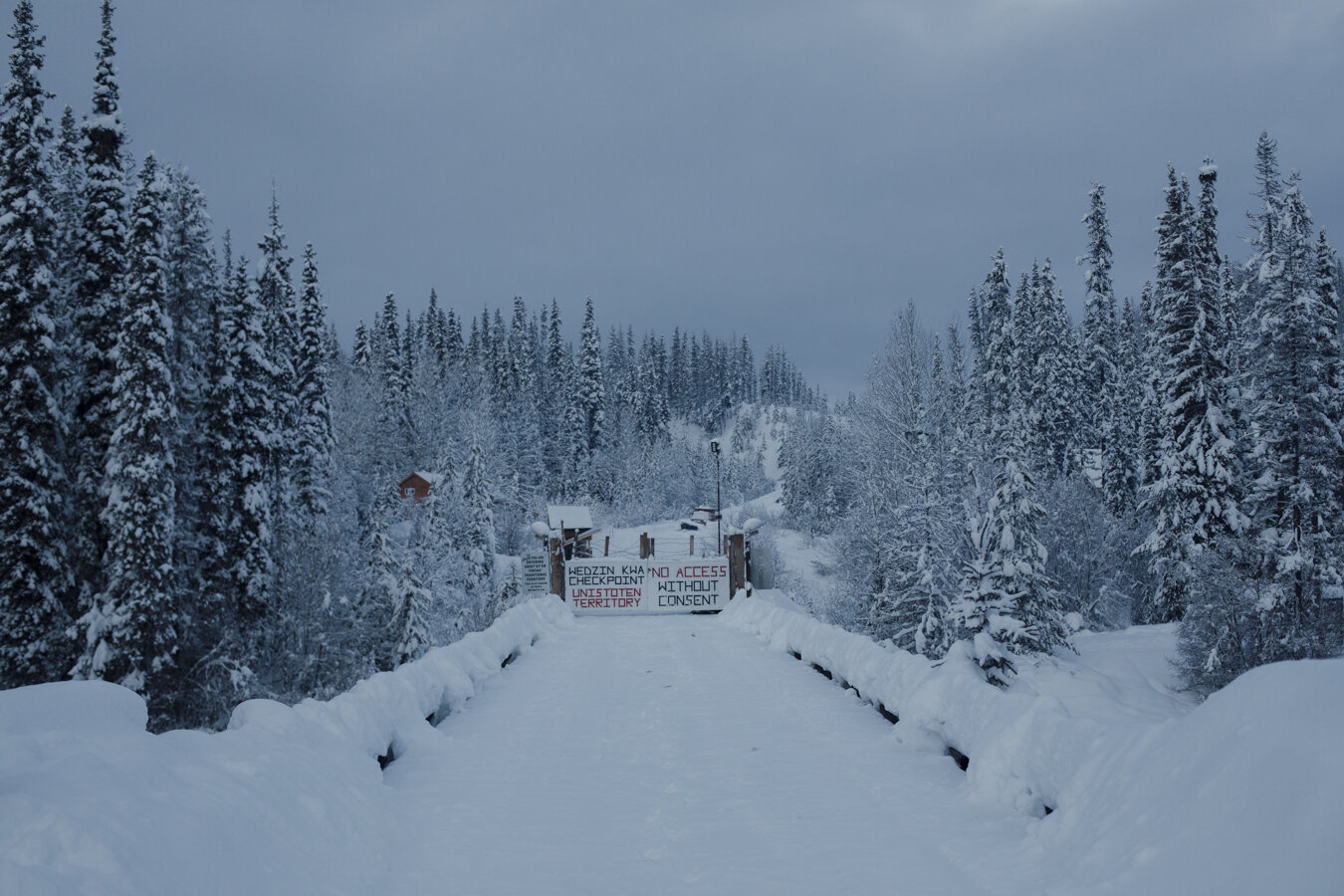
I’ve been going to the Wet’suwet’en camps, and following the story there since 2015. The Wet’suwet’en assertion of rights to their territory has bearing on a very long list of Indigenous nations who have never signed treaty, and is supported by many structures in Canadian law. What is happening there is a modern iteration of hundreds of years of violent dispossession of Indigenous lands. It’s direct evidence that colonization has grown somewhat gentler over time, but has never ended — we as a society still want the land, without the people.
Last year when the injunction was expected I was very concerned about an unwitnessed RCMP action in that remote area, and so I went.
Pick one photo from your series to deconstruct: what was happening when you took the shot? Set the scene, what was going through your head?

Sabina Dennis on the barricade. That day was brutally cold and the camp had been on alert for days, so no one had slept very much in the wall tents and buses. RCMP were pushing and twisting the gate, but there were people tied to it down below so the force was twisting their bodies and they were screaming in pain. An officer was starting a chain saw. Everyone was calling out, trying to tell the police that they were there, “Stop! You’re going to break their arm, you are going to break their arm.” It seemed like it took a very long time for police to believe them, though they did stop eventually.
Molly Wickham, who is the Gidimt’en spokesperson, was singing a Wet’suwet’en song, even until she was arrested too.
It was a very small space, at the edge of a narrow bridge over a creek: there was a bus behind us, the gate in front of us and maybe 20 or 30 camp supporters all holding ground. I’m not sure I had time to process very much, but I was looking for a vantage, I needed to show the police at the barricade, and I was looking for some of the intensity of emotion that I could hear and feel. But with most people facing away, towards the police, it was difficult to capture. Sabina had been praying, calling out and so I had been watching her, when she looked back the composition came together and the picture was made. It’s the image that stays with me from that day.
What did you learn from this project/series?
RCMP will spare no expense to respond in force to unarmed, peaceful Indigenous opposition. They came with sniper rifles, semi automatic weapons and combat ready uniforms. There’s even reports that they had authorized lethal force.
Dive Deeper
Photographer Amber Bracken recognized something deeper than a protest was afoot when hundreds of tribes gathered at the Standing Rock reservation in opposition to the Dakota Access Pipeline. See the project at https://mediastorm.com/clients/2018-icp-infinity-awards-amber-bracken