
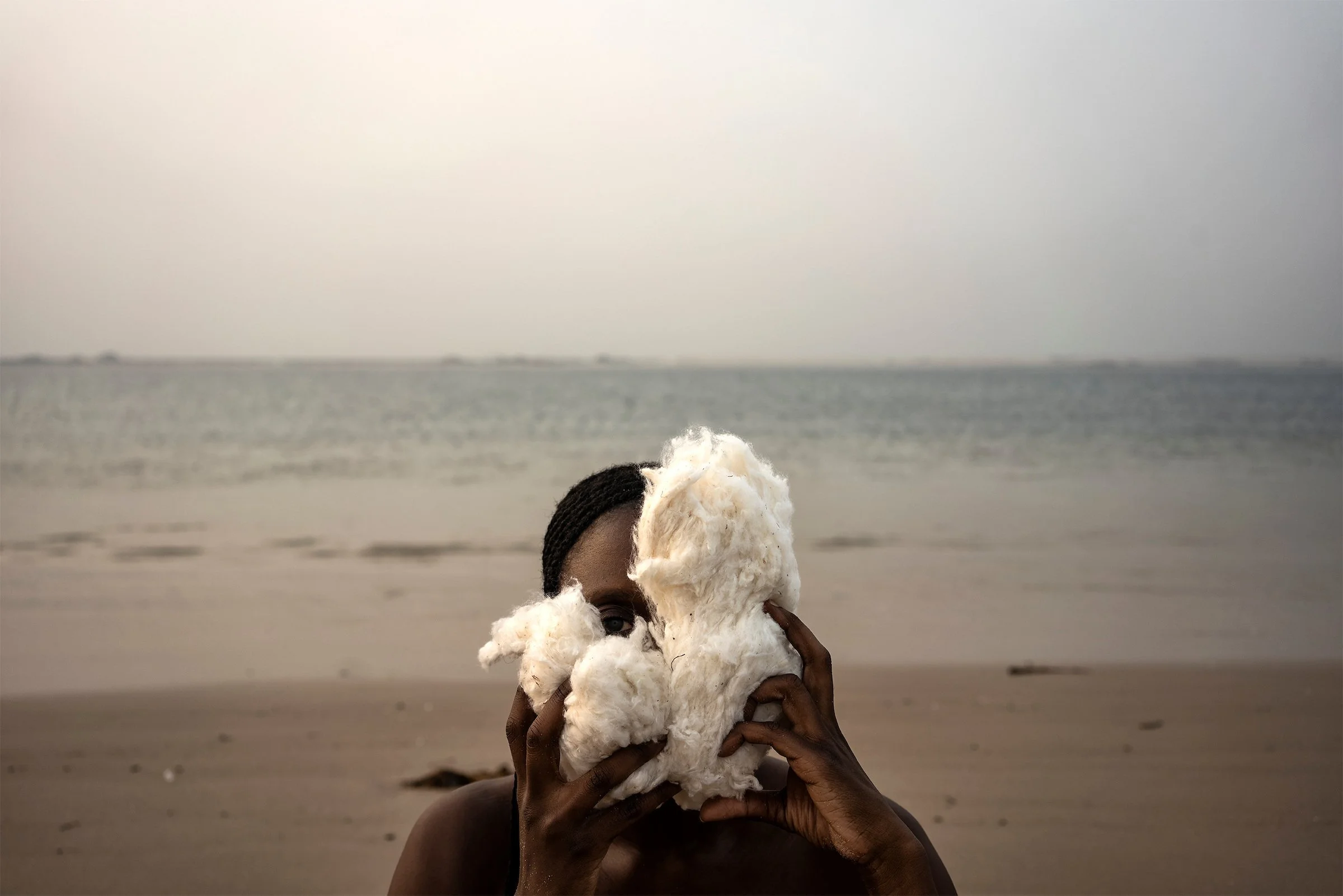
Photographer and mixed-media artist, Adama Delphine Fawundu, shares select works to illustrate the power of visuals to “uncover the past, activate the present, and meditate on equitable futures.” As a CatchLight Global Fellow, Fawundu is creating open-source learning resources for artists and educators to leverage visuals as tools for literacy and critical learning.
📍 Lagos Island, Nigeria

She, they, we remember through our bodies, the water, the spirit, the space. Rhythmic waves meet the shores of Lagos Island, Nigeria; they vibrate Awori, Eko, Oxum, Oshun.
To position oneself as the central figure within a photograph is most challenging. I never consider them to be self portraits, but more so a representation of the collective self.
When I am photographing other people, I often think about the spiritual agreements and exchanges between us.
When I am both in front of and behind the camera, a deep level of introspection and reflection occurs on a personal and universal level.
Many of my portraits are made within the natural environment. I often ask, “What does the ocean remember?”
I am reminded to listen, remember, and imagine just and equitable futures.
📍 Abidjan, Ivory Coast

Everything is always in motion, all happening at once, hence, everything is everything.
So much of my photography is about space and forcing myself to think outside of the sociopolitical and oppressive notion of place.
My body intuitively connects to space, and although it may not be possible, I try to represent the feeling through photographs.
📍 Brooklyn, New York

Pre-pandemic, I was commissioned by the Park Avenue Armory to take part in an exhibition celebrating the ratification of the 19th Amendment. However, once COVID-19 hit, we were forced to create digital projects.
Thinking deeply about ancestral memory and the perception of history, I created a Freedom Cape alongside a video documenting the Cape’s construction, as well as my own performance wearing the garment.
The Cape is composed of documents that represent a complex and layered global history, highlighting the contributions that women of African descent have made to voting rights in the United States.
This photograph is layered: The Cape is history through primary documents. The land is Prospect Park, holding memory of the Lenni Lenape people, as well as the enslaved people from the Lefferts Plantation and Flatbush Brooklyn.
The Lefferts Historic House is pictured in the background. The being, wearing Mami Wata shells, is symbolic of the transient nature of time and space.
I am reminded to listen, remember, and imagine just and equitable futures.
The energy already lived within the enslaved bodies. Perhaps it is this energy that fought for freedom.
📍 South Hampton, Virginia

This image was photographed in South Hampton, Virginia, on the plantation where Nat Turner was born. The woman wears a dress hand-dyed by her Grandma Adama’s hands, worn often by her mother, within — Matriarchal energy insists.
She imagines: What if the Mende Spirit transcended space and appeared on the Turner Plantation in the 1800s?
The energy already lived within the enslaved bodies. Perhaps it is this energy that fought for freedom — this energy that understood freedom despite a system of enslavement.
Ancestral memory, energy, power.
📍 Garrison, New York

I’ve been photographing my Sons (aka Suns) since they were babies. Pictured here is my eldest son Amal, 26, at Bear Mountain.
The focus was on his hair communing with the sun and surrounding energy.
About the Author

Adama Delphine Fawundu is a photographer, visual artist, and 2022-2023 CatchLight Global Fellow based in Brooklyn, New York. Her distinct visual language, centered around themes of indigenization and ancestral memory, enriches and expands the photographic canon. Fawundu is co-publisher of the critically acclaimed book MFON: Women Photographers of the African Diaspora.
The CatchLight Global Fellowship was made possible with support from MPB.