
Authority Collective took over our Instagram feed this week to feature images from around the United States as tens of thousands of people protest against police brutality and the systemic racism that contributed to the deaths of George Floyd, Ahmaud Arbery, Breonna Taylor, and many others. Photographers Vanessa Charlot, Diana Cervantes, Lynsey Weatherspoon, Sarahbeth Maney, Tara Pixley, Rachel Elise Thomas, Chloe Collyer and Nora Williams share their photos and reflections from their recent work covering the protests. Special thanks to Danielle Scruggs and Tara Pixley for their curation support.
Diana Cervantes (@dee_sea_photo)
The following images chronicle the quiet, yet strong and tender moments often lost in the chaos of protest coverage. It is my belief that capturing these moments is just as important.
I was drawn to create the first image when I saw discarded flowers lying on the street. I was unsure if they had been lost in the brief chaos of the moments before, but I appreciated the juxtaposition of the beauty with representations of authority in the background.
As I lagged behind protesters, I saw Joshua standing on the side of the street holding his fist in the air in solidarity as was his baby daughter—a sight which was incredibly moving and heartbreaking at the same time. I approached them and Joshua shared that he felt compelled to show Luna what he and the Black community are fighting for, as well as his hopes for a better future for her.
Joshua smiled and said he wasn’t trying to make Luna raise her fist, that she was doing it on her own because she understood the importance of this moment.
Joshua and Luna represent not only how racism impacts generations of families, but also the resilience and ongoing struggle to create change in a system that often neglects the rights of communities of color.
After a long day, I could tell people were growing weary as the march over the Brooklyn Bridge was quiet except for the sound of cars below. I felt compelled to capture the softness and peace of this moment as the remaining bits of daylight began to fade. It reminds me that the road to change is often long, hard and not seen in the limelight.

Photo by Diana Cervantes | Flowers left behind by protesters lie in front of a group of NYPD officers near Foley Square in Manhattan on May 29, which marked the second day of protests and uprisings throughout the city. Hundreds took to the streets to continue demanding justice for George Floyd, who was killed by Minneapolis police last week. 
Photo by Diana Cervantes | Joshua holds his 8-month-old daughter, Luna, as protesters march down W 28th St and Broadway on May 31st, marking the fourth day of protests and uprisings in NYC. 
Photo by Diana Cervantes | Protesters march across the Brooklyn Bridge from Manhattan as a day of protests stretches into the nighttime hours of May 31st, marking the fourth day of protests and uprisings across the city.
Vanessa Charlot (@vanessa.charlot)
There are moments in history where a photographer is moved to capture and create work that dismantles our false notions of propriety. As a documentary photographer and black woman experiencing this as I stand on the frontlines, I’m very clear that this has always been the only option that exist for me. An inner resolve to capture images of black resilience and resistance, not in comparison to but in spite of. The people you see in this photographs are ultimately and inevitably an extension of my own being.

Photo by Vanessa Charlot | May 29, 2020. Downtown St. Louis. Protesters, including this black woman, block a major intersection demanding justice for the senseless killing of George Floyd. 
Photo by Vanessa Charlot | May 29, 2020. Downtown St. Louis. White allies join the movement with signs expressing their silence makes them complicit in the violence. 
Photo by Vanessa Charlot | June 1, 2020. Gateway Arch National Park in Downtown St. Louis. Protesters gather at the park as a rallying point to chant and commune. Protesters hold up their fists and carry Black Lives Matter signs in solidarity.
Sarahbeth Maney (@sbmaneyphoto)
I struggled to make a decision of whether I would attend the protest or not. As a black female photojournalist I had to be real by asking myself questions such as: will I be safe I chose to go? Will I be able to handle this emotionally? What type of impact will my images have?
There are so many angles and perspectives to photograph a protest from. I really wanted to make images that could have meaning and resonate with those around me. When I looked up at the sky and saw three men standing side by side, at first glance, it translated a sense of unity and and power – all the way up there, they seemed untouchable from everything else.
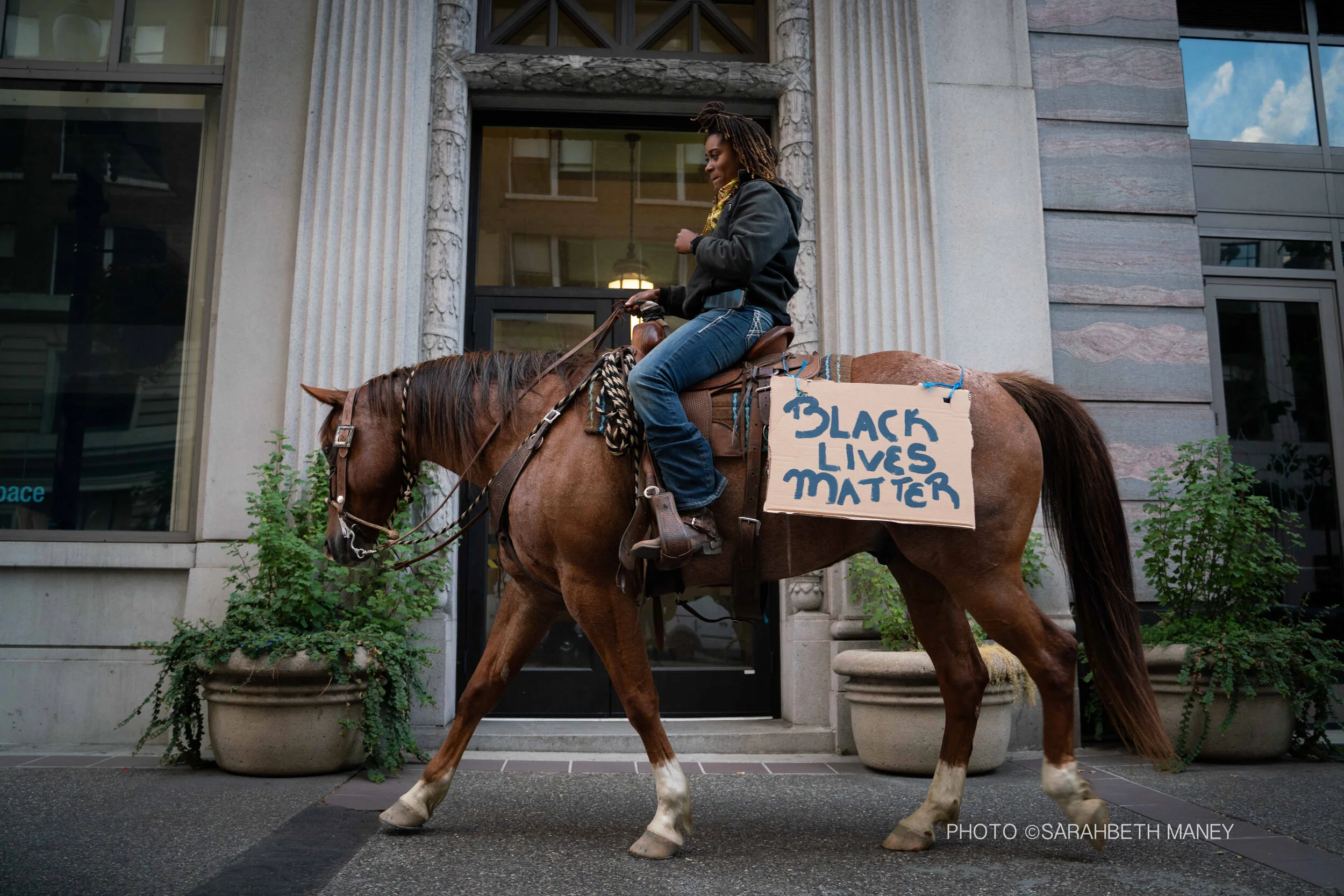
Representation is extremely important to me when making images. I photograph what I see, but I also photograph what I feel. When I spotted Brianna Noble riding her horse alone through a sea of protesters, I was immediately struck by her confidence, bravery, and strength to attend the demonstration on horseback, which was a statement in its own.

Photo by Sarahbeth Maney | A demonstrator shouts at police officers while crouching on top of a bus stop during a protest in honor of George Floyd on Friday, May 29, 2020 in Oakland. 
Photo by Sarahbeth Maney | A group of men gather on top of a roof to view a demonstration of more than 5,000 people gathered to honor the life of George Floyd and protest police brutality on Friday, May 29, 2020 in Oakland. 
Photo by Sarahbeth Maney | Brianna Noble, 25, rides her horse named Dapper Dan, through the streets of downtown Oakland at the start of a protest honoring George Floyd on Friday, May 29, 2020.
Photo by Tara Pixley (@tlpix)
Thousands marched through the streets of Hollywood in Los Angeles on June 2, protesting the killings of George Floyd, Breonna Taylor, Tony McDade, Ahmaud Arbery and countless other black lives lost to police violence. The sense of community, compassion and call for change was palpable.
On the corner of Hollywood and Vine, police formed a link and several dozen prepped police batons pointed at the protestors in order to let a truck through an intersection barricaded by police bodies and vehicles. At this same intersection, the police barricade blocked many from accessing the nearby train station.
Several protestors discovered a man laying unconscious on the sidewalk in the sun and collectively moved him to the shade, leaving water bottles in his hands. Other protestors signified their ability to provide First Aid care by displaying a paramedic emblem.
I describe some of these moments here because not all consented to be photographed and some (like the unconscious man) could not give consent. While I am privileged to be able to photograph these protests in relative safety as a professional photojournalist, I am always a human first. Protecting the safety and security of those I photograph is just as important to me as telling accurate and holistic stories. The intersection of my right to photograph people in public and their right to publicly assemble in protest should not automatically mean I publish images of people who asked not to be photographed. That is an unconscionable act that is counter to the sentiment of Black and brown bodies protesting state violence, surveillance and killings. Just because you CAN do something doesn’t mean you should.

Photo by Tara Pixley | June 2, 2020. Los Angeles. Thousands marched through the streets of Hollywood protesting the killings of George Floyd, Breonna Taylor, Tony McDade, Ahmaud Arbery and countless other black lives lost to police violence. 
Photo by Tara Pixley | June 2, 2020. Los Angeles. During the peaceful protests, people marched through the streets chanting, honked from nearby cars to show support and passed out water, masks, hand sanitizer and snacks to the crowd. The sense of community, compassion and call for change was palpable. 
Photo by Tara Pixley | June 2, 2020. Los Angeles. Police blocked off several streets, not allowing the crowds to gather together most of the time and sometimes making it difficult for people to access the nearby public train stations.
Chloe Collyer (@chloetry)
Protests are familiar to me. I’ve been documenting them for years.
But something new is happening in this country and it’s an honor to witness it.
The Friday after George Floyd’s death protests began in my neighborhood, and like many documentarians I didn’t hesitate to pick up my camera. But I was exhausted that night when I saw white men smashing windows and climbing buildings while black protesters pleaded for them to stop.
I went out the next day, and the next, as demonstrations continued on. More and more people seemed to be coming out of their quarantine and into the streets, so I continued to document until the seventh day of protests when I finally rested. Feeling guilty about staying home, I spent the day watching live feeds of the protests around town.
As I continue to document, I’ve realized photographing the protests has been a coping mechanism for the anger and pain I feel. It’s extremely therapeutic in the sense that it keeps me connected to the people and communities around me.

Photo by Chloe Collyer | A healthcare worker looks on as speakers address a large crowd outside Seattle’s City Hall during the ‘White Coats for Black Lives’ march. Thousands of medical professionals, students and civilians gathered in solidarity with the Black Lives Matter movement on Saturday June 6, 2020. 
Photo by Chloe Collyer | An unnamed protester holds a sign memorializing George Floyd in Seattle’s Othello Park. Thousands gathered to march through Seattle’s historically underserved Southend on Sunday June 7, 2020. 
Photo by Chloe Collyer | Indigenous artist Abriel Johnny helps lead a march of thousands through Seattle’s Capitol Hill neighborhood on the sixth day of consecutive protests. After rumors circulated about previous protest leaders working with police, local community organizers took up the mantle and led activities for the day on Wednesday June 3, 2020.
Rachel Elise Thomas (@implied_wisdom)
In the midst of protesting and marching, I have discovered that it’s not always about the things that are going on within a crowd of people that’s important, it’s the moments that are happening off to the side that a lot of people may not notice that grab my attention that are just as meaningful.
The young man in the first image is Cameron Calarsky and he’s a recent graduate of Detroit Cristo Rey High School in Detroit, Michigan. This moment was so special to me because in the midst of protesting and marching, you are reminded of the beautiful things life has to offer and even with a mask on his face, I could feel his pride. He could’ve celebrated anywhere, but he decided to come downtown during a protest and be seen with his cap and gown and what better place to do that?-especially since COVID-19 has eliminated the chance of having a traditional commencement ceremony. I couldn’t let this moment slip by. I’m very proud of this image.
One of the things I’ve noticed in these protests-especially during a pandemic, is that protesters have found unique ways to show solidarity and resistance through fashion, personalized signs and face masks. It gives way to much needed self-expression in a time where we are still social-distancing and had to isolate for a period of time. I think because of that, people have so much more they want to say and get off their chests and now is the perfect time.

Photo by Rachel Elise Thomas | June 6, 2020. Detroit, MI. The young man in this image is Cameron Calarsky and he’s a recent graduate of Detroit Cristo Rey High School in Detroit, Michigan. 
Photo by Rachel Elise Thomas | Maurice McDonald of Detroit displays solidarity from the sunroof of his Yukon as protesters march down Woodward in Detroit, MI on Thursday, June 4, 2020. 
Photo by Rachel Elise Thomas | May 30, 2020. Detroit, MI. The second day of protesting began at DPD headquarters in downtown Detroit where we marched from there to Southwest Detroit and back again. Southwest Detroit is an area of Detroit known for its Hispanic population, neighborhoods and stores. We marched in solidarity with immigrants and families/individuals who have been affected by deportation and ICE while also honoring George Floyd and all the Black lives that have been lost to police brutality.
Nora Williams (@noraw.jpg)

By being on the front lines, I wanted to depict a narrative that was different than what the media was portraying. Thousands of peaceful protestors marched throughout the streets of Charleston, SC advocating for the cessation of police brutality. During these protests, the unity fueled everyone to keep marching. Batons, tear gas and riot gear did not deter the crowd from marching on. It felt surreal capturing history in the present.

Photo by Nora Williams | Charleston, SC. When I saw this sign held high in the sky, I thought to myself here we are once again. When will it ever end? 
Photo by Nora Williams | Charleston, SC. Two things we are fighting against, a pandemic and racial injustice! #blacklivesmatter 

Photo by Nora Williams | As everyone stood together to fight against racial inequality, the sound of his trombone rang through the streets of the historic downtown Charleston, SC.
Lynsey Weatherspoon (@lnweatherspoon)
A city wrapped in the cloth of the South’s most treacherous moments. It’s not the 50s or 60s. This is today. Black folks are tired. Tired of a system that continuously brings us to our knees. We dig our heels so deep into the ground, we no longer see our feet. We keep fighting and hopefully moving toward a space where we can be able to simply breathe.

Photo by Lynsey Weatherspoon | Atlanta. May 29, 2020. Protestors in Atlanta, Georgia for the death of George Floyd and other African Americans killed by police brutality. 
Photo by Lynsey Weatherspoon | Atlanta. May 31, 2020. A wreath of flowers spell “BLM” 
Photo by Lynsey Weatherspoon | May 29, 2020. Protestors in Atlanta, Georgia for the death of George Floyd and other African Americans killed by police brutality.