
Introduce yourself: tell us who you are in a few sentences and give us a little background on your career path thus far.
I am a curious person, someone who seeks to continue learning and discovering things every day, and who found in photography a way of expression and an excuse to access realities and people who would have otherwise been inaccessible. I am passionate about human nature, about the complexities that each society weaves, and I use the image to document and transmit what I feel is worth highlighting and remembering.
What is your earliest memory with photography?
My grandmother’s family photo albums. I spent most of my childhood with my Spanish grandparents, and every once in a while, my grandmother would take family albums out of the closet. Sitting on the sofa, we watched those photos while she told my brother and me anecdotes about the past, about how she and my grandfather left the countryside with few coins and a mattress to migrate to the capitol in search of more opportunities. Although I had already seen those photos many times and had them recorded in my memory, I always enjoyed seeing them again. And I still do.

Describe your approach to visual storytelling?
My objective is to understand and analyze each story that I want to tell and look for the visual approach that best allows me to address that story. This allows me to, on the one hand, feel comfortable while working on it, and on the other, to bring the story closer to the public in the best possible way. I think that each story has a way of being told and that is our challenge as storytellers, to be in constant exploration. Logically it is necessary to differentiate between working on an assignment for one or two days than working on a personal project, the implication cannot be the same.
What is one piece of advice you would give to those just starting out or looking to improve their visual storytelling skills?
I would tell them to find their motivation to do this job, to understand why they do it and to believe in it. Passion is essential in any job, if you enjoy what you do and find meaning in it, surely every goal you set will succeed. And on the other hand, let creativity flow. How each of us builds images has a lot to do with our personal journey, with our anecdotes, experiences and interests. And so each one has a different route when selecting a story and when telling it. It is essential to have that connection with yourself, and experience a process of reflection when we are going to start a project, to really know that this is the story we want to tell.

How did this particular project come about? Why were you interested in it?
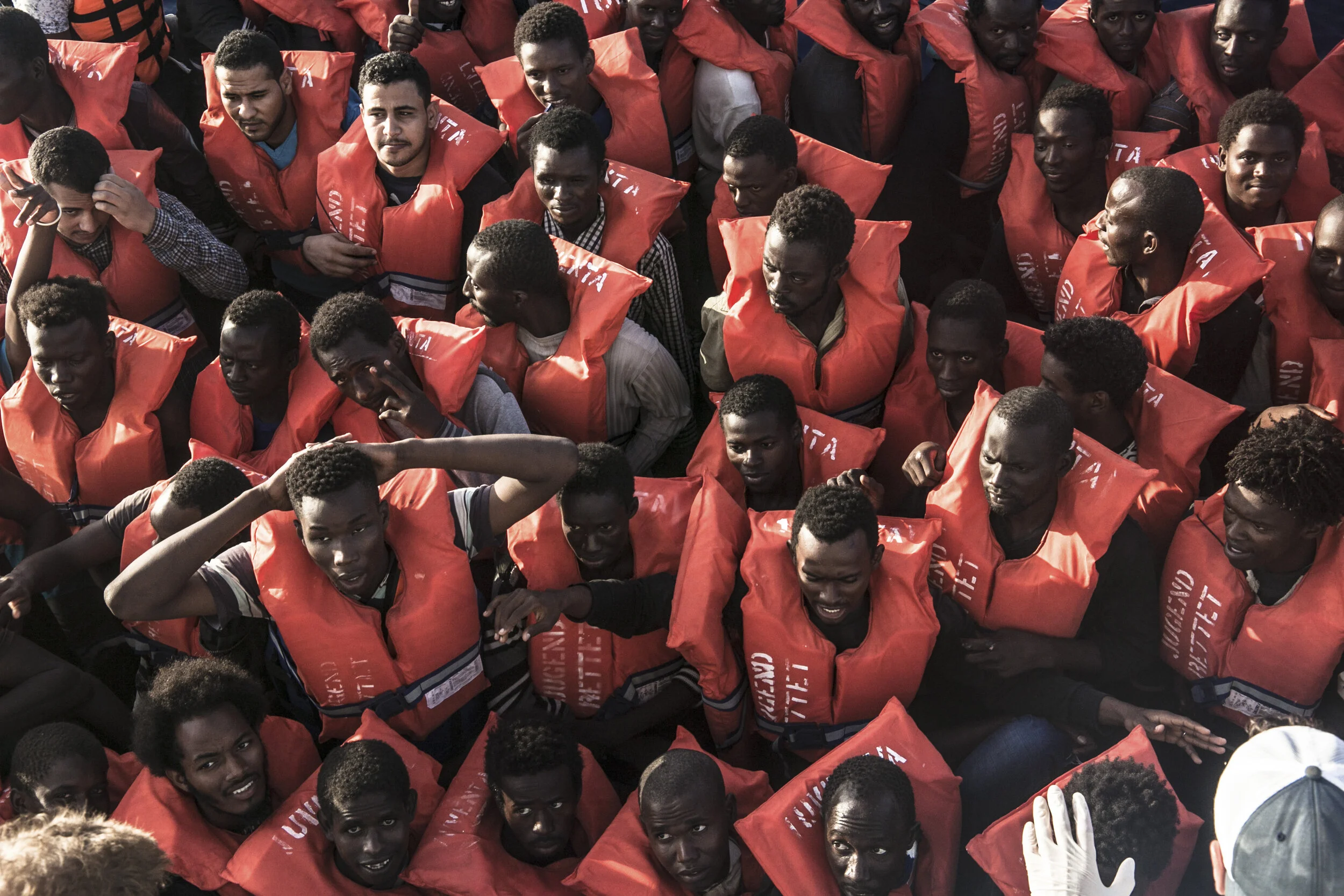
Migration processes have always been fascinating to me, and I speak of migration processes in a more abstract way, not only thinking about contemporary migratory movements, but also thinking more broadly on the role of migration in the origin of humanity as we know it today. It is possible that being the son of a migrant, and my internal conflicts about nationality, race and belonging to a place, also awakened certain curiosities. All this led me to want to see for myself and document the migratory process that was taking place in the Mediterranean Sea in 2016, to want to know who were those people who were risking their lives crossing the sea in terrible conditions. It is in this context that Passengers was born. I gained access to a German rescue boat that was beginning in July 2016 maritime rescue work near the coasts of Libya, and it is on board that boat that I made the first series of portraits that underpins the project. 118 portrairs of all the people traveling aboard the same boat adrift in the Mediterranean Sea. The objective was to approach in an innovative visual way that reality so that it would help build empathy towards those people who were always included under the homogeneous label of ‘migrant’.
How does this moment impact how you view both yourself as a visual storyteller and your project?
This context is being a challenge for everyone, it has made us face ourselves, questioning who we are and our role in society and in the world. And this time of reflection logically extends to all those projects already started. In these months of confinement, I have had time to rethink the Passengers project and ask myself if what I am doing really makes sense or if it will once the pandemic has passed. And the reflection I make does not differ much from the one that motivated me to start the project: migratory movements have always existed and will continue to exist. They are part of the essence of nature, and this pandemic is nothing more than a parenthesis, that once it passes it will give way to new movements, perhaps some caused by the pandemic itself, and therefore we will return to the same debates that we were having before. With this project I am trying to address a specific context of contemporary migration that I believe should be documented and analyzed so that it becomes part of the collective memory of future generations, and the pandemic will become one more stage in its development.

What has been a specific surprise or challenge of working on this project?
It is a project that requires time. Without the four years I have already dedicated to it, I would not have been able to get to where I have come. But having managed to sustain the development of the work over time, maintain the enthusiasm and energy and find the resources to carry it out, is being complex. And that need for time is due to the fact that having been able to locate practically all the 118 passengers of that boat rescued in 2016 would not have been possible overnight. After seeing all those boys rescued at sea, our contact was lost, and yet throughout these four years, little by little and with many difficulties I have been able to build networks, locate them and rebuild their journey. But it’s being a beautiful process, which is making me grow personally, meet wonderful people and learn every day.
What motivates you to keep making pictures? In one sentence describe why visual storytelling matters to you
Telling stories has become a necessity and a way of life for me, I have found in it a way to feel fulfilled and through which to contribute something to the society in which I live. I firmly believe in the power of the image to generate a positive impact in the world.
***