

Introduce yourself: tell us who you are in a few sentences and give us a little background on your career path thus far.

I’m Samantha Cabrera Friend. In a day, I can be a friend, sister, daughter, performer, writer and artist. Returning to Chicago, after years away, I feel my most self here. Chicago is unlike any other city. It’s filled to the brim with people who are making undeniably important work in every field imaginable. Watching others lead their own unique way here is what gave me a place when I felt I had none.
What is your earliest memory with photography?
My earliest memory of photography would have to be my mom wedging her 35mm camera in between trees and things. She would use a self timer and make photos of me, my brother and herself when we were hiking, camping, or just being outdoors. My aunt added a lot to my memories too, always having a camcorder in hand. I remember not thinking anything of it, but it probably made me feel pretty comfortable around cameras. They were always objects loved ones controlled.
Describe your approach to visual storytelling?
I never start photography thinking about concepts of journalism or storytelling. For most of my life, I really did not identify in the journalistic world. Studying art and photography at school is what trained me to center my mind and acknowledge my own lived experiences, curiosities and shortcomings. My “approach” to visual storytelling then is to honor my instincts and first experience things as a human.

There is also a lot of time spent conducting research around my proposed work before I begin asking others for their time. There’s no pressure yet and it feels respectful and necessary to get immersed in your research.
Life also feels easier when there is conscious collaboration in your practice. This is one reason I love using a large format camera! It’s so fun, performative and obvious, I love how everyone has an opinion and gets involved. As a result, I’ve sort of sworn off trying to make images quickly or discreetly.
What is one piece of advice you would give to those just starting out or looking to improve their visual storytelling skills?
You’ve absolutely got this, just keep going! Keep following your own passion compass, then spend time to unpack the how and why. Truly the best advice I can give is just that. To keep making work you care about, and most importantly to keep that work close by. Look at it, live with it, learn from it, and no matter what, continue on.
How did this particular project/body of work come about?
This work came as a visual continuation of the important work ProPublica reporter Tony Briscoe created on the history of disinvestment in the West, particularly the neighborhood of Garfield Park. Before anything, I did as much research as I could. I needed to hear the sentiment from intergenerational Garfield Park residents about how their childhoods looked so different from what many people associate with Garfield Park today that it can be hard for younger generations to imagine a better time.
I had experimented with historical counternarratives in my own work and community with an online public research project called Quinceañera Archives. It felt like Quince Archives was my guinea pig where I had learned a lot. After that, I definitely felt I could create a better structure for applying a citizen archive practice in practical, approachable and collaborative ways in real life.

Reflecting on this project — what were your main learnings? How did this work inform your practice as photographer and identity?
This work emboldened me to believe in both visual and spoken voice, two things I feel preserve memory in deeply poignant, unforgettable ways.
I’ve never gotten the support to work on a project I care about for this long. Acknowledging that timeline is pretty integral to this work. It helped me feel supported enough to learn that it’s the in between times — the quick unrecorded stories, slow moments, waiting outside someone’s home, taking every unscheduled call, the times in between production — when you feel the most connected to the energies you’re creating with your work or “story.”
It’s almost as if the more hands that reach out to support something, the more beautiful and precious it becomes.
Then a project like this, a community-driven story, becomes so powerful it gives off an energy and reward even at rest. That’s how I feel sitting with the work now. I’m excited to spend even more time with it and learn even more after this.
How does this current historical moment impact how you view both yourself as a visual storyteller and the work you’re creating?
In the current historical moment, meaning global pandemic, I would say I’ve grown to prioritize patience and move more slowly. We are human beings first. I’ve become more attached to concepts of taking time to understand, preserve, and celebrate one’s lineage, community, and self … whatever that looks like for you. In this world of uncertainty, I feel myself agreeing even more so with the thought of pychosociaologist Jacob L. Moreno, “Spontaneity and creativity are the propelling forces in human progress.”
What has been a specific surprise or challenge of working on these images?
A surprise would be how extensive everyone’s collections of family and personal photos are. There are objects that simply could not fit on a scanner. The variety of adjacent objects with photos (frames, folders, glass, books, albums) made me think about photography beyond the physical print. It’s been a long time since I’ve gotten to learn about photography through methods so tactile.

Another surprising thread to unravel was hearing residents think they don’t have enough photos, or the “right” photos, and so on. Not only is that never true, it’s quite the opposite! It was a great set up for a conversation around an approachable truth, that everything one has already done and collected is enough and absolutely extraordinary.
Pick 2-3 photos from your series to deconstruct: what was happening when you took the shot? Set the scene, what was going through your head?
Below is an excerpt from the “head notes” I wrote directly after two of my large format portrait sessions. I try to write head notes after all photo interactions. Especially when I experience something so beautiful, immersive and social, when I come home it’s time to unpack my fresh memories and feelings however I’d like.
••••••
Head notes excerpt from Shacarra Westbrooks final portrait, 06/28/2021 20:12 CT

Full scale fireworks set off a few houses down. A hot lime green car stops and says hello to everyone before passing. Guys arrive on tiny motorbikes. Women move their folding chairs closer together and get the tiny grill out of the frame. So many more men join the photo, so many more women. More babies, more kids and a few more teens. Most began saying cheese audibly as soon as they sat down. I let them know it will be 2 more minutes before the film is in the camera and ready. Luckily, I delivered on that promise. It felt surreal because of how many more people continued to come in for the photo, moving, shifting the frame and I just felt calm. Not that I was not energetic, ecstatic, enthused. But it’s just part of the work and I have time to explode and scream in happiness later.
I’ve come to realize this camera forces you to keep your cool. There are too many hot little moving parts to get distracted and having an excuse to remain calm and focused is okay.
Towards the end of the day, when the shutter has to go slow, and the clouds cloak our sun, Shacarra takes a mock picture with the view camera of a few young men in her family, holding the shutter release cord and pressing it herself. Others took cell phone photos of this same angle, so it felt great to allow all parties a pageant process. I only said it once and learned after a groan reaction that I should avoid saying this again. No matter who you are, no one wants to hear “There’s no more film.”
••••••
Head notes excerpt from Pastor Hatch final portrait, 06/03/2021 22:48 CT
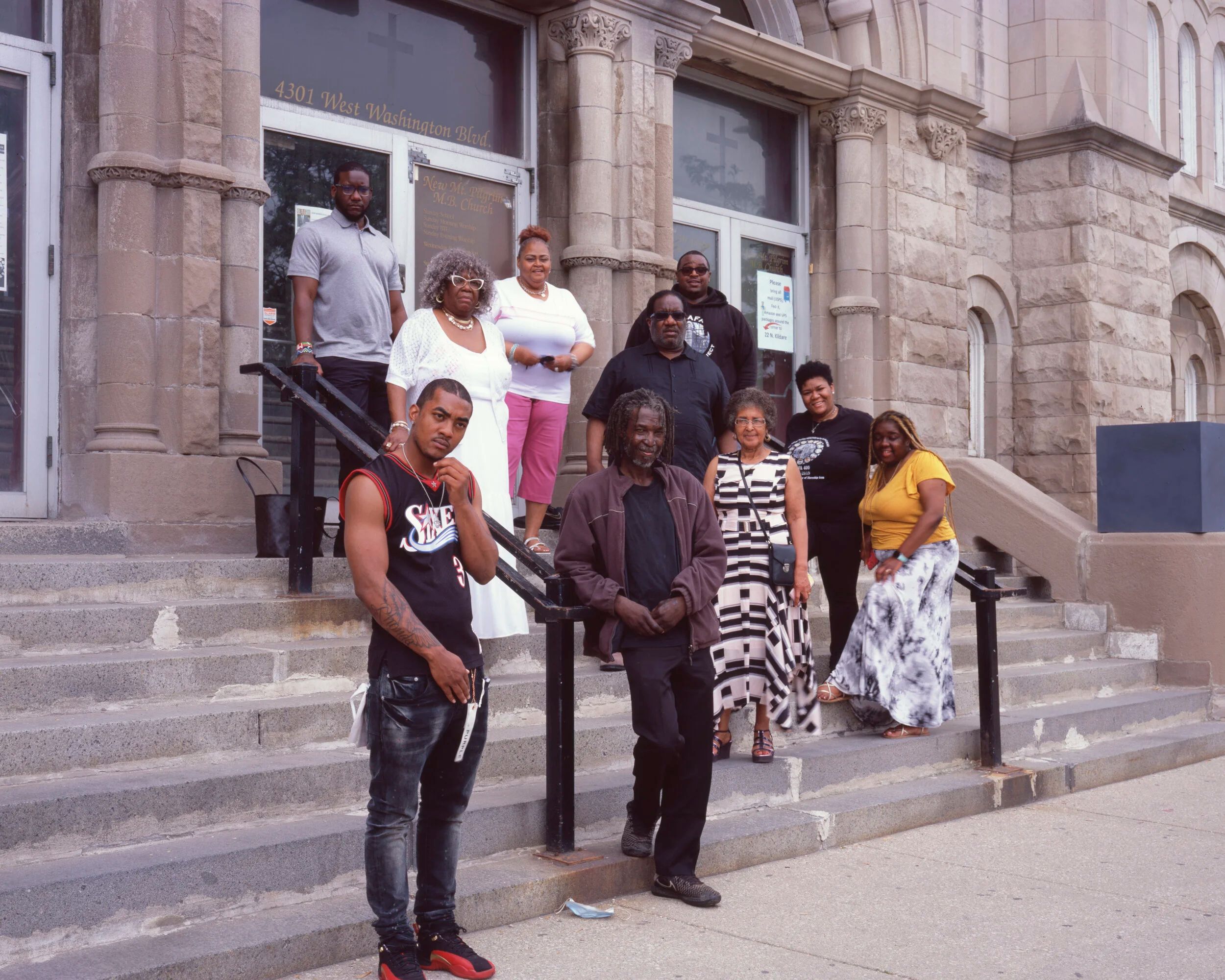
I would run up the few steps to either hold the door open for those who were exiting the church, or already catch them on their way down as they tried not to look at the camera. “We’re going to be making a historical portrait of the Hatches.” After a response, I replied “You’re welcome to join.”
When the Hatches joined us outside it was quite a dance to arrange everyone who came in and out of the photo. The fun part for me, the “why though?” part for many. After some thorough testing on this low lighting day, I became aware I was testing patience when they called me a good salesman. “Just one more!” Everyone laughed, and my mind shot at lightning speeds past insecurity, worry, or burden, and sunk into a nest of laughter and creative self awareness. It was time to wrap up and that we did. After I likely threw a thumbs up (my bodily reaction to communicate through a mask and international symbol for we are DONE) I showed some my large format process, dark cloth, focusing and all. As I drove home I remembered a photo I wished I had asked the group to rearrange just once more to have made, but I still feel aflame from the fact that I made 9 images today. As I write this I still have not seen them but I remember them and live them well.”
What motivates you to keep making pictures? In one sentence describe why visual storytelling matters to you
Visual storytelling matters because visuals hold a unique power to reshape public perception and change culture.