
Introduce yourself: tell us who you are in a few sentences and give us a little background on your career path thus far.
Hi! My name is Nicole Buchanan and I’m a documentary photographer based in Atlanta. I received my BFA from Rhode Island School of Design in 2015 and have shown in galleries and museums across New England, as well as, here in Atlanta. My work analyzes race, culture and identity while challenging societal constructs of racism and prejudice.
What is your earliest memory with photography?
My earliest memory of photography has been with my great grandfather constantly photographing our family. He always had a camera around his neck when got together during the holidays. My grandfather (his son-in-law) also was an avid photographer throughout his surgical career in the operating room and throughout my life. The moment I knew I wanted to learn more about photography occurred after I laid my eyes on the beautiful portrait of Sharbat Gula from the 1985 cover of National Geographic.

Describe your approach to visual storytelling?
Capturing the everyday is just as important as documenting large historical events in my opinion. From protests to sitting in the dining room of my grandparents’ house without being able to take off my mask, my photographs include details to tell you about the subject or the environment. Their belongings, the eyelash that sits on their cheek down to the expression on their face will further the story.
What is one piece of advice you would give to those just starting out or looking to improve their visual storytelling skills?
Even if a story takes several years, don’t let go of that project. Sometimes we get wrapped up in the idea of we have to finish a project in order for it to be shown to the world. Stories take time to unfold, it’s not a sprint, it’s a marathon.

How did this particular project/body of work come about?
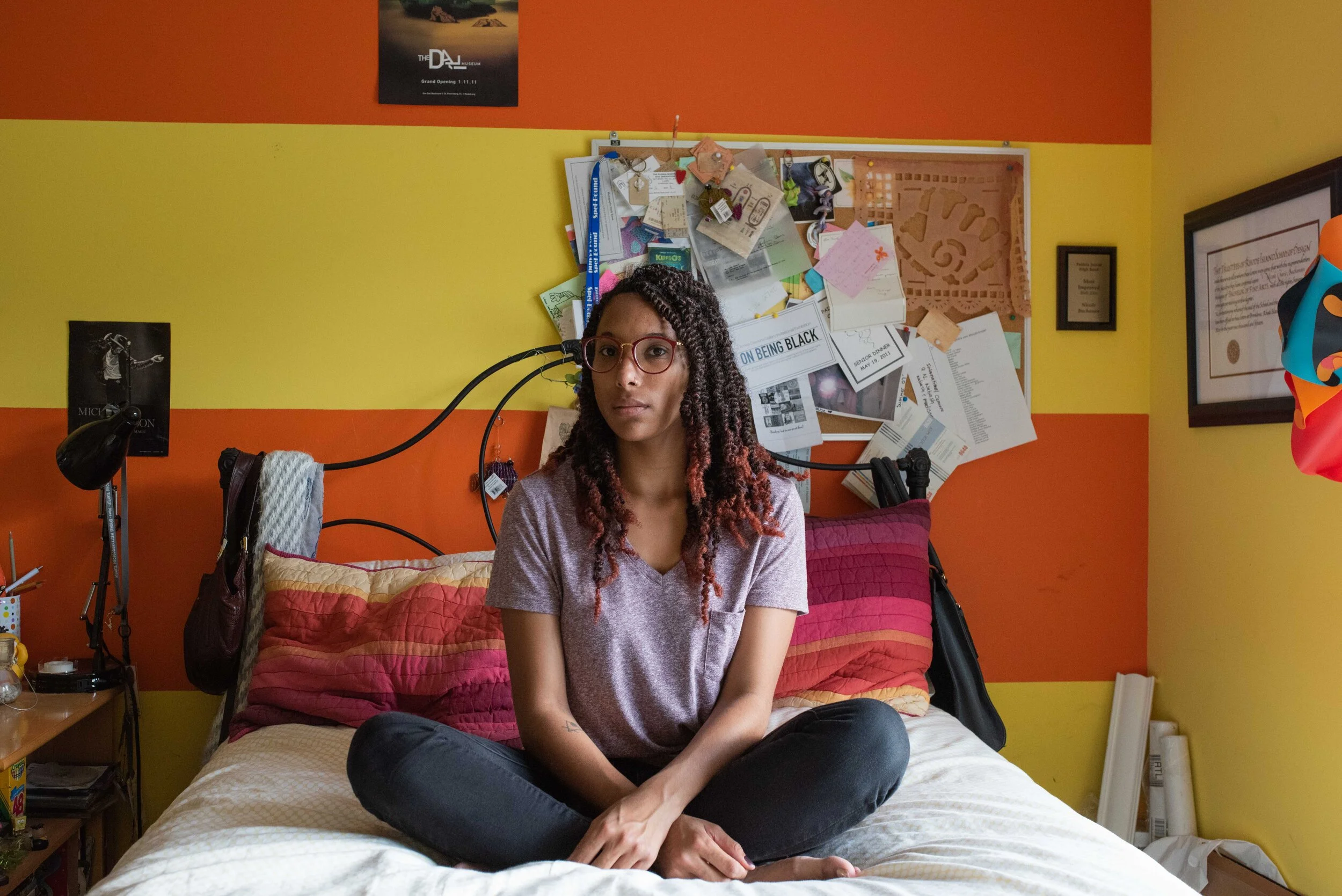
While a student at Rhode Island School of Design, I realized I was the only black student in every class I took. Coming from the south, this was very different from what I was used to even thought I went to a private white school from first through twelfth grade. After this realization, I wondered if I was the only black student thinking about this so I reached out to a few that I knew. I discovered I wasn’t alone in this experience and wanted to document what this looks like with my peers. This work was the beginning of my thesis and shaped a lot of how I take my environmental portraits now. As you move to the more recent portraits of myself and the one of myself sitting next to my mother and twin sister; these were taken while I’ve been working from home and able to see my family more. Currently, I’ve been working on a closer view of my family to further discover how I’ve become the person I am today.
How does this current moment impact how you view both yourself as a visual storyteller and the work you’re creating?
Life is crazy right now. With police brutality and racism being the forefront of every conversation, alongside the pandemic, it’s difficult just to simply exist as a black female in America. However, this has allowed me the time to start a new body of work which focuses on my family and diving deeper to understand who I am while I tackle a familiar form of depression and anxiety. I could’ve worked on other stories but I needed to spend time telling my own story rather than focusing on everyone else.

What has been a specific surprise or challenge of working on these images?
The challenge I faced with the photographs of the students in their dorm rooms was lighting. There wasn’t much natural light and most of the time and typically we were meeting up after class int eh evening to make the portraits. I had to work with some really awful hot lights because I hadn’t taken studio lighting, yet which was required before being able to rent strobes.
I also had difficulty shooting in the dorm rooms because they aren’t very wide so shooting horizontal images was very difficult to get the individual’s whole body in the frame.
Pick 2-3 photos from your series to deconstruct: what was happening when you took the shot? Set the scene, what was going through your head?

The portrait of myself alone in my childhood bedroom was the start to really uncover that I’m hiding a lot of things. Sharing these secrets and fears is my strong suit. I keep them behind a wall that’s as high as outer space. I’m starting to try and figure out why I do that. My childhood bedroom was where I kept my dreams and desires. I thought about where I wanted to be as an adult and what I wanted to do in my career. That cork board is only a fraction of what I would do to bring inspiration. I pasted up an entire wall’s worth of magazine cutouts to constantly remind me of what I loved. My hopes and dreams.

The portrait of the young man on the bed with a tiger blanket thrown across the bed and his paintings surrounding him, is one of my favorite portraits. There’s a lot of information in every corner of the portrait and that’s what makes it unique. We actually had several setups before arriving at this portrait. IT was a collaborative effort between him and I. We laid out all of his Naruto comic books and photographed him holding a few. However, this was more illustrative of who this individual is as an artist.
What motivates you to keep making pictures? In one sentence describe why visual storytelling matters to you.
The endless amount of stories that exist is one of the main reasons why I continue to make pictures. I am constantly fascinated by the people I meet serendipitously at a coffee shop or while traveling. Deep down, I truly believe there are wonderful parts of people that exist, we just need to know how to reveal them.
Visual storytelling matters because without it, we wouldn’t have the unique perspective on stories around the world that everyone needs to experience.
***
Nicole’s work was selected as part of our Artists Against an #Infodemic campaign — a project by CatchLight, Dysturb and The Everyday Projects made possible thanks to the support from the John S. Knight Journalism Fellowships program at Stanford University and PhotoWings.
The project draws on images by photographers, muralists, street artists, and illustrators from around the world to bring greater attention to public health messages. Working with memetic distribution expert Pamela Chen, and Dr. Jenell Stewart, DO, MPH, an Infectious Diseases specialist, the collaboration utilizes the power of visuals to contest misinformation and disinformation in communities where infection rates are most prominent, and to improve public communication and news delivery surrounding COVID-19 to underserved communities.
RACISM IS AN ONGOING PUBLIC HEALTH CRISIS THAT NEEDS OUR ATTENTION NOW.
