

In my year-end reflection, I look back at the local visual journalists who stayed when the national cameras left, and the change our work makes possible.
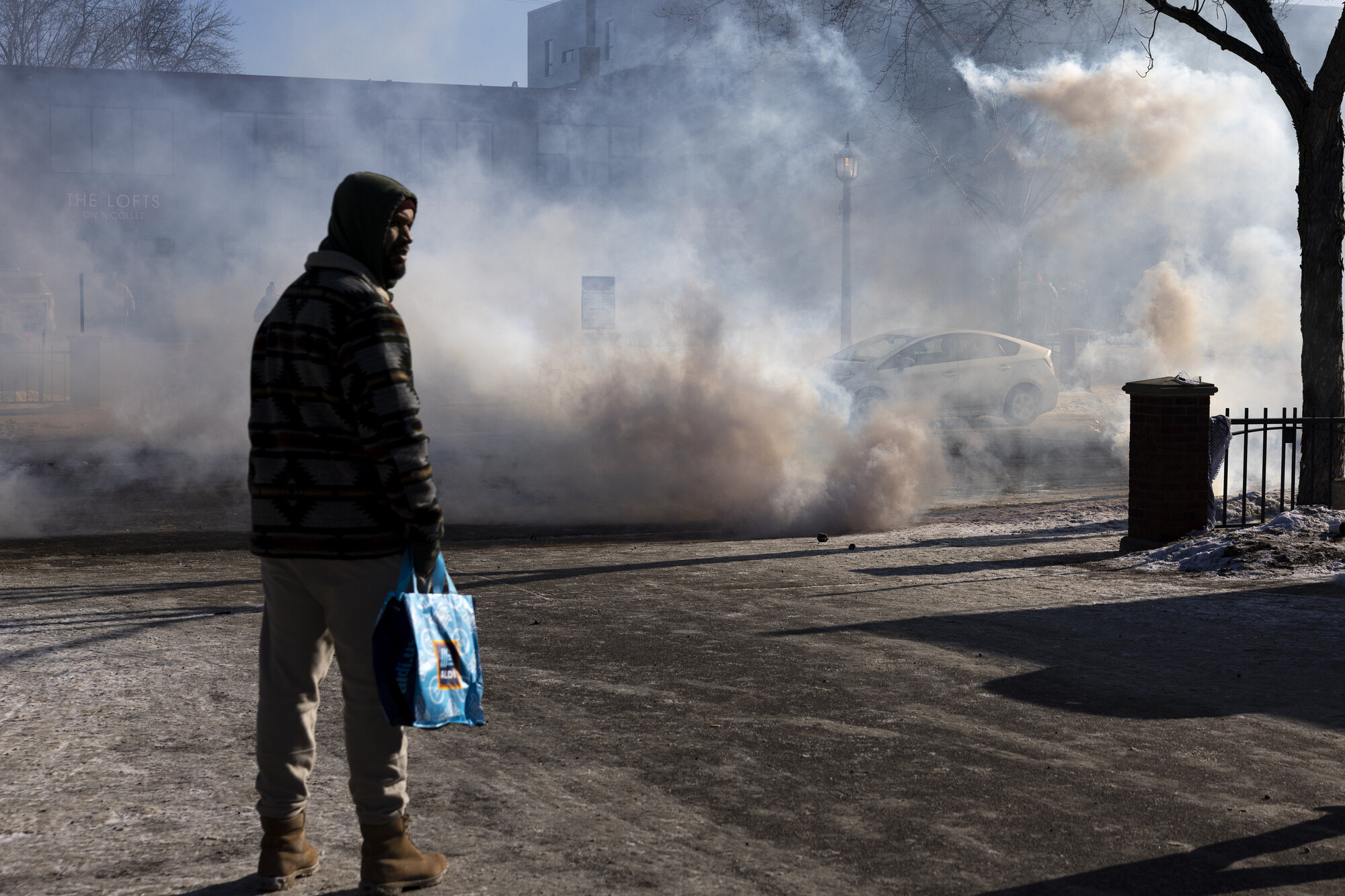
There are two photographs from this year that I keep coming back to. The first one is a picture of a man holding a bag of groceries on his way home by Ellen Schmidt. A banal image, if only the street were not covered in tear gas. Earlier this year, Ellen was a CatchLight Local Fellow at MinnPost.
For weeks last winter, as immigration enforcement operations led to protests across the city and three shootings, two of them fatal, MinnPost and our other Minnesota member newsroom, Sahan Journal, kept reporting, often at real personal risk. When the national cameras packed up and left, they stayed. Because for journalists like Ellen, there is no exit door. They do not fly in. They do not fly out. They live on the blocks they photograph. The grief they photograph is the grief of people they know.
And our team stayed with them. I am so proud of what our editors did in those weeks, around the clock. They edited images as events unfolded, put safety protocols in place, made sure the photographers had support for what they were carrying home, and got their work to the wires and cross-promoted in national outlets so the whole country could see it.

And then there is a second photograph, taken on those same streets ten months later. Two hands work in unison to press “I voted” stickers onto a pole. An image of community, an image of remembrance, an image personifying the power of democracy. Bridget Bennett, who took over the fellowship at MinnPost from Ellen, watched as voters stopped at the memorials to Renee Good and Alex Pretti, one by one, and came back to honor them until the pole was covered in red. When I first saw it, I had to stop for a moment. It felt like a circle closing. The same streets that held so much grief in January were holding something else now: people honoring Renee and Alex in the most hopeful way a democracy offers, with their vote.
Both times, someone who belongs to that community was there with a camera, so that the rest of us could see it too. This is why I do this work. Because if no one shows up with a camera, the story disappears. And when the story disappears, so does the accountability. Images are one of the last true ramparts to our democracy. This second image inspires hope in the common action of community. The key is the continuity of documentation between those two moments.
Over the last year, I got to watch the work of these visual journalists, editors and newsrooms lead to real change.
In Shasta County, the sheriff’s office announced it would resume in-person family visits at the jail, days after Shasta Scout documented a pause of more than ten months. In Wisconsin, Wisconsin Watch’s investigation into data center secrecy deals fueled a bipartisan push in the Legislature to ban them.


In Montana, the story began with one family’s grief. Amy Young, a Billings nurse and mother of three, died by suicide while enrolled in the state’s required recovery and monitoring program for medical professionals. Her mother and eldest daughter told Montana Free Press that the program’s costly, rigid requirements had left her with little hope of returning to the work she loved. Her death had not even been noted in the reports given to state licensing boards.
Lauren Miller, our CatchLight Local Fellow at Montana Free Press, photographed Amy’s family with great care, giving a face to a loss the system had overlooked. The day after the story ran, the state’s labor commissioner announced a review of the program, which covers more than 60,000 doctors, nurses and other medical professionals. Together with a state audit, the reporting led to a new advisory council to oversee it, and within two months the company running the program announced it would leave its state contract.


The moment that moved me most was a quieter one. We brought a CalMatters photo essay about loneliness among older Californians back to the Culver City Senior Center, where it became the first photo exhibition the center had ever held. Seventy-eight people came to the opening, and the seniors pictured in the work took their prints home as keepsakes. That is journalism returning to the people it is about.


I am grateful for how far we have come together. Our network now includes 22 newsrooms in 16 states. Our first thematic desk, on mental health, published 91 stories that reached nearly a million people and sent $150,000 in grants to local newsrooms. And CatchLight Live brought all of this into rooms full of people in San Francisco, Chicago, London and Austin.
22
CatchLight Local member newsrooms across 16 states all of which have seen improvements in audience reach & engagement
91
Stories produced by the CatchLight Focus: Mental Health visual desk that have reached nearly 1 million people
10
Years of the CatchLight Global Fellowship which has so far issued $870,000 to 29 fellows since 2017
In its tenth year, our Global Fellowship welcomed three visual storytellers whose work rests on the same thing as everything else in this letter: belonging to the places they document. In Bethel, Alaska, Katie Baldwin Basile makes multimedia stories together with communities and young people across the Yukon-Kuskokwim Delta, where climate change is already redrawing the map. Some villages, like Newtok, have had to move entirely, and her work centers Indigenous knowledge and daily life as people adapt. In South Africa, Gulshan Khan continues The Things We Carry With Us, a long-term body of work on Muslim communities in Southern Africa. It traces the legacies of the Indian Ocean slave trade, exile and segregation, and also the resilience and love that endured. In Dominica, Michael Lees is developing Behind God’s Back, a cinematic portrait of the abandoned village of Petite Savanne and the people who keep returning to a landscape they were told to leave. Three places, one shared conviction: the people closest to a story are the ones best placed to tell it.


That is why, next year, we will take this work further than I once dared to imagine. We are building larger partnerships with national, regional and local media networks, so that the images local photographers make on their own streets can reach audiences across their regions and across the country, without losing the trust and closeness that made them possible. And alongside our partner newsrooms, we will carry what we learned from the mental health desk into new themes and new places.
I know how many causes ask for your attention at this time of year. Thank you for making room for this one. Your support keeps a photographer on the street when the story is hard, an editor on the other end of the line, and the work finding its way back to the people it is about, and far beyond.
If you can, please consider a gift that feels meaningful to you this season. And whether or not you can, thank you for believing, as I do, that how we see one another matters.
With gratitude and warmth,

Elodie

Banner Image:
A man looks on at the scene where an observer of immigration enforcement operations was shot and killed by a federal agent on Saturday, Jan. 24, 2026, in Minneapolis.
Photo: Ellen Schmidt / MinnPost / CatchLight Local / Report for America