
Aïda Muluneh’s ‘Still I Rise’ ushers in the next generation of visual storytellers
The most important quality we seek when choosing a CatchLight Fellow is a generosity of spirit—a deep desire to improve the field of visual storytelling through leadership, knowledge sharing, innovation and, of course, the highest quality images.
One Fellow who exemplifies these qualities is Aida Muluneh.

Aida became a CatchLight Fellow in 2018. Already a globally celebrated photographer, exhibited at many institutions including MoMA, Aida came to CatchLight to support the next generation of visual storytellers across regions of Africa.
In 2019, she completed her first series of workshops in Uganda, Ethiopia, Côte d’Ivoire and Italy with more than 25 emerging photographers. In 2020, we expanded our support of Aida’s workshops through a $12,500 grant coming from our Impact Fund.
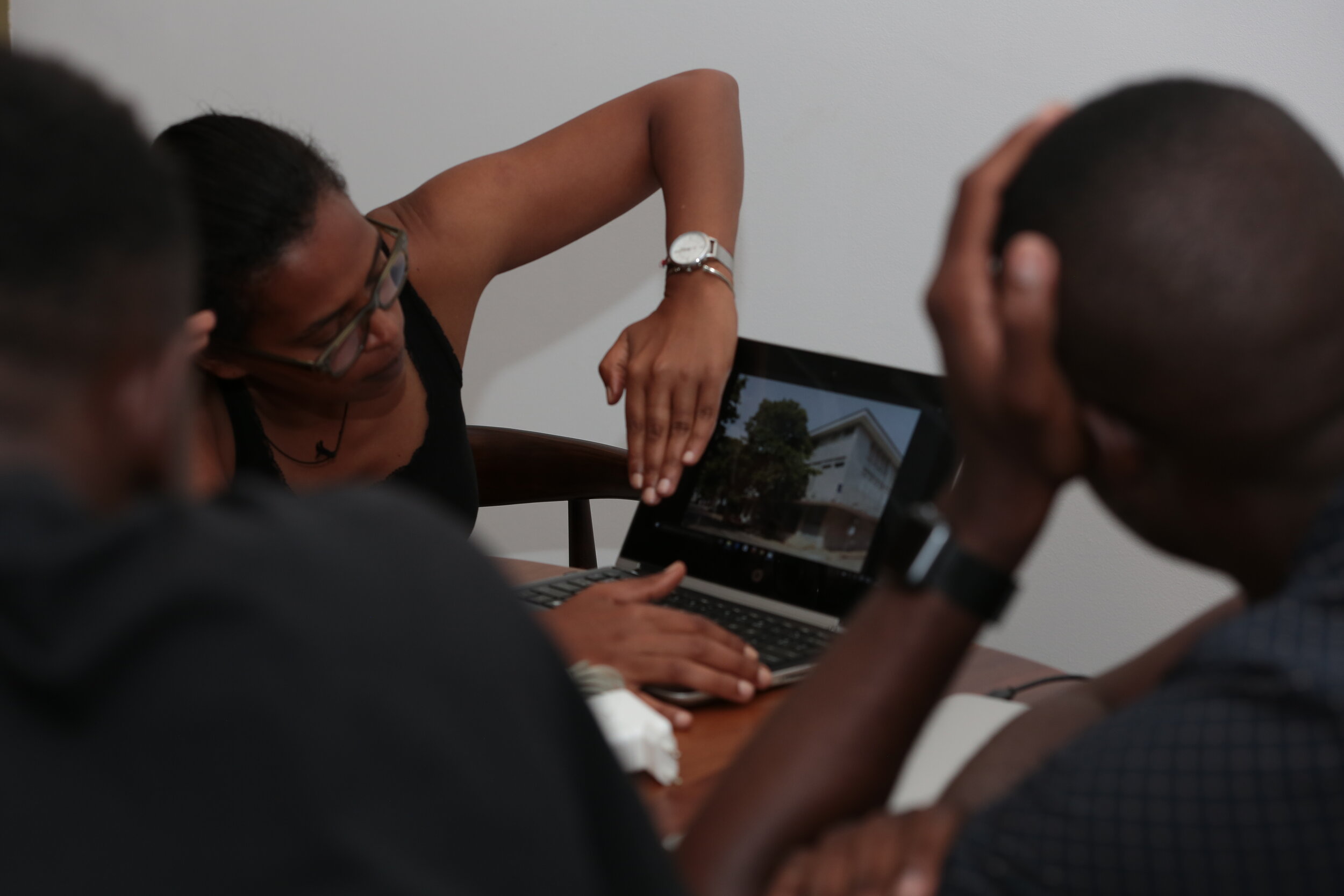
On Dec. 18, “Still I Rise,” opened at Fondation Donwahi in Abidjan, featuring Aida’s groundbreaking work and—highlighting her commitment to mentorship—that of her students from the workshops which took place in Ethiopia as well as Côte d’Ivoire. The exhibit contains “work to make you vibrate through perseverance and hope.”
Aida is also a globally sought curator. She recently put together the exhibition “Crossroads Ethiopia” for the Nobel Peace Center that featured archival work from the Addis Foto Fest, which she founded. Also for the Nobel Peace Center, Aida created work to celebrate this year’s Nobel Laureate, the World Food Programme featuring photo series on food in war and conflict. Additionally, you can see some of Aida’s work virtually in the exhibit “Homeward Bound.”
Just as our Impact Fund underlines our belief that Fellows are Fellows for life, Aida makes real the ideal that CatchLight Fellows’ leadership move the field forward.

Abel Gashaw
The Addis Ababa native and a computer science graduate grew an intense interest in photography at the tender age of 15 and started capturing the motions and objects in his everyday life with a regular camera. When he turned 18 he started exploring some of Ethiopia’s most iconic historical sites, taking his camera along, which enabled him to capture Ethiopia’s magnificence, uniqueness and originality. Abel has a deep appreciation for nature, life and people. He currently works as a freelance photographer.


Abel Takele
Director/editor at a media company in Addis Ababa, who also works as a freelance photographer and videographer. His passion for photography didn’t start at a young age like most photographers; it was something he discovered while he was studying for his bachelor’s in computer science in Addis. He became fascinated with photography and soon after started learning everything he could from different sources. Fast forward today, he is fully submerged in the arts world and creating content he is passionate about.


Abenezer israel
Israel developed an interest in cameras and photography in 2015 when he joined Addis Ababa University to study broadcast journalism. Upon graduation he started working with award winning photographer Aida Muluneh as a communication officer for Desta For Africa (DFA) where he learned more about photography and continued to develop. Abenezer tries to show through the pictures he takes the beauty he sees in the world. He is focused on developing his artistic and photography endeavours by actively learning from and working with the best professionals in the field.


Addis Aemero
Though trained as an agricultural economist, the 26-year-old female photographer has had a long and enchanting affair with photography from a very young age. Highly influenced by both her mother and grandfather, who were photographers, Addis grew up with a dream to one day have her own photo studio. Addis’ work has been featured by Blank Wall Gallery in Greece, the Center for Photography in Ethiopia, Addis Foto Fest 2018, Nobel Peace Center in Norway and the Sharjah Art Museum. Addis now understands that photography has the power to preserve the past and the present for the future.


Aurélie Jocelyne Tiffy
This young Ivorian is passionate about the eighth art. Born in 1996 in Aboisso in the southeast of Côte d’Ivoire, Aurélie grew up and did her primary cycle in Ayamé, a village located 136 kilometers from Abidjan. Very focused on her studies, she succeeded brilliantly in 2007 in the entrance examination in sixth grade and was subsequently directed to a high school in Abidjan to continue her studies. She soon developed a great passion for artistic photography and audiovisual production. Through every image she captures, Aurélie strives to sing the melody of our daily life.


Mohamed Aly Diabaté
The documentary director and photographer, born July 30, 1990 in the economic capital of the Ivory Coast. Passionate about cinema, he joined the Institute of Sciences and Techniques of Polytechnic Communication in Abidjan in 2013. After five years of rigorous training spent at ISTC Polytechnique, he graduated with a professional master’s degree in Audiovisual Production and Directing. Upon entering the professional world, he worked on humanitarian projects that aim to tell the stories of people that spur social, educational and cultural change in West Africa.


Dago Nadi Jessica
This Ivorian photographer is passionate about travel and culture. Holder of a diploma in Visual Communication Web Programming option, it is after her BTS that she meets photography and in July 2017 that she decided to dedicate herself to this art. With photography as a weapon she wants to show Africa, her Africa, differently: an Africa united in its cultural diversity.


Lucien KABLANKAN
A freelance photographer, Kablankan approaches his work above all as an Artist. Born in 1960 in the south east of Côte d ‘Ivoire in Adiaké, Lucien is quickly noticed for his photographs of landscapes. He is inspired and influenced by the works of great European and African photographers such as Jacques Marsi, Jean Claude Coutausse, Bruno Boujdelah and Boubacar Toure Mandemory. After obtaining the first prize of the national photography competition (your God my God) organized by the Goethe Institute of Abidjan in 2008, he participated in several internships of the Goethe Abidjan Institute as well as high profile international workshops. He most recently participated in a photojournalism workshop organized by CESTI in Dakar, Senegal.


Koffi Alex Mac Donald
Born in 1997 in the suburbs of Yopougon in Abidjan (Côte d’Ivoire). He studied law but always nurtured a passion for art and photography. In 2018 he began his apprenticeship in photographic art with the intention to promote his cultural values in a contemporary style. His meeting with the photographer Aïda Muluneh led him to discover photojournalism and as a result another facet of photography. This inspired him to start capturing moments of history to be carried to future generations.


OLIVIER KHOUADIAN
Born in 1988, Olivier has been passionate about art in general and writing in particular since his early childhood. Following a career in finance, in 2017, unable to resist this call any longer, he decided to give up everything to eat, live and breathe photography. His encounter with the artist Aida Muluneh was a decisive moment in the orientation of his art. This encounter generated an interest in street photography and photojournalism and inspired him to conceive of an artistic universe steeped in the meeting of cultures. A subject that is particularly close to his heart, because his generation is increasingly feeling the effects of globalization and of the modern communication channels that break down all borders.


Klervie Mouho
A Franco-Ivorian artist born January 7, 2000, Klervie lived most of her life in Abidjan. She is in the third year of higher education at the Beaux-Arts in Angers (TALM).
Beyond the photographic medium, in which she has recently evolved, her work is built around drawing and her extensive textile research. The question of memory is omnipresent in his works, whether it is to constitute and edit archives, to transmit or question the marks left by past events on collective and personal imaginaries.


Samson Seleshi
At 24-years old, Samson graduated in construction management. He has been experimenting with photography for the past four years. To develop his photography skills, Samson has attended various workshops. He has created a social media platform where amateur photographers can share their works and learn from each other.


Sylla Cheick
Photographer and computer graphics artist for five years, he works and lives in Abidjan. Attracted from a young age by the digital world which aroused his curiosity and a little later by graphic art and photography, Sylla decided to train in computer graphics just after obtaining his baccalaureate in 2008. Ivorian youth has always been Sylla’s driving force and his source of inspiration. A self-taught photographer, he express his gaze on the youth of Ivorian society through black and white photographs mainly, which strongly underline the expressions and emotions of the subjects photographed and which put the human in the foreground.


TEWODROS GIRMA
The fourth-year computer science student and native of Addis Ababa first fell in love with photography when he was 18. He started off by taking pictures with his phone. Proving the age-old saying that a picture is worth a thousand words, through photography, Tewodros found a platform to express his thoughts, without uttering a single word.


Zahui Mamby Arsene Yvann
Known as May on social media and born June 18, 2001 in Marcory (Abidjan) in Ivory Coast. He did his secondary and university education in Ghana. May has a degree in Multimedia Computer Graphics and is a Graphic Designer and Motion Designer by profession. May’s artistic technique is defined as a form of surrealism.His goal through his artwork is to draw the attention of this generation to the realities they face.


Q&A with Aida Muluneh
By Abby Connolly, CatchLight
Can you tell us a little about the origin of your student workshops? What made you decide to launch these masterclasses?
We’re living in a continent where a lot of things are happening. I was one of the first people doing street photography saying ‘OK, we need to document these changing faces of our nation.’ We don’t need people to fly in to tell our own stories. Photography has political Impact, it has economic impact, it has social impact and for me, it’s important to be at the lead of our own narrative.
The key challenge is looking at the development of the industry in my own country. When I came back to Ethiopia in 2007, I felt it was important to teach. The easiest thing is to have my work on white walls in museums, the most challenging thing is helping emerging talents.
A lot of times young people are looking for that catalyst, that opportunity to open their minds. My main job is to open their minds for them and for them to understand the full spectrum of what photography is.
After now teaching these workshops for some time, what have you learned? What are your key takeaways?
These students give me great energy. The students end up feeding back into remotivating me and it’s been really an exciting process. Over time, we’ve seen a complete shift of when they submitted, when they did their first second or third assignment and so forth; and they start to see things differently. This process has been, for me, quite amazing.
Students that I have trained have entered the international market. In the long term, I expect them not to be the best in Ivory Coast or Uganda, I expect them to be the best in the world. We need to compete on that level, in the global audience. It’s really about how we create a leader out of you and how we get you through the process and into your future career.
What are you learning about which opportunities are missing and which ones are strong for emerging photographers if they want to stay and work on the continent?
The missing link for me that I understood is there needs to be lessons on the business side of photography and understanding how to promote the market yourself because that’s the biggest game — you can have great images but if you don’t know how to promote yourself then you’re not professional and really not getting that far.
At the end what I’m trying to make them understand is they need to decide if they are going to have a short term career or a long term career. A long term career requires proper planning, you can’t open a business without having a plan. So since this is one of those crafts that you can just pretty much pick up a camera and consider yourself a photographer, the success of a photographer now really depends on understanding the market fully — not just by creating the content but by understanding how everything functions.
What do you see as the next step in building out this infrastructure for new storytellers and artists?
I need to open a school, that’s basically what it comes down to. I realized that the way that I’m teaching, it’s more than a text-book teaching, the rest is about how to think about photography and how to use it as a tool of self expression. So far the experience I’ve had with the students is that they need more time to develop and this is why building a school is going to be that key factor. I’ve been teaching for a long time and I’ve seen how that transfer of knowledge has made an impact on a lot of photographers.
What are some things you would say to young photographers and possible future students who would be interested in your masterclasses?
I’m in museums not because someone saw me on Instagram, because I’ve done the work, I’ve built collections. Opportunities lead to other opportunities. I’m bringing them international attention so the kind of students I’m looking for are the ones where I say jump, they just tell me how high.
And that’s how the success of the Ethiopian photographers who are already in the pipeline has looked — they basically follow the lead of the long term agenda and now I get messages five years later like ‘you know, we didn’t understand at that time, we were immature, but now we understand what you were trying to tell us, what we need to do with our careers.’ That’s all I want, to me, the more photographers we have in the pipeline, solid photographers, the better we can have an impact on the industry.
How has this pandemic impacted how you view your role as an educator and catalyst for change? What challenges, opportunities, value shifts, etc. has it brought up in your work?
I think the future is virtual and I believe as Africans we need to virtually exist with as much content as possible. At the beginning of this whole Covid thing everyone was like ‘oh Africa is going to go hell, this and that, but you know we fared up quite well — things didn’t stop; we had to move forward. And actually the bigger challenge that we faced was not really Covid but because it was elections in the midst of us trying to get the workshop together. It was challenging for the students because they couldn’t really be out there, I mean people were coming out with machetes we’re not talking about demonstrators with flags and red hats, so that created a fear in the students. So we had to push through that. But my point is that these challenges come up and we have to find ways around it, and really navigate to make things happen.
What is clear to me is that we have to have our voices in there in this moment of history to document what we can and the virtual thing is so key. We need to have a stronger consistent presence online that continuously pumps out work from emerging talent.
