
Introduce yourself: tell us who you are in a few sentences and give us a little background on your career path thus far.
My name is Kathleen Flynn and I’m a documentary filmmaker and photojournalist in New Orleans. My work is centered around social justice and bringing about accountability while building understanding.
I got my start studying photojournalism (using black and white film and printing in a dark room) at Western Kentucky University, graduating in 2001. I went on to work as a staff photographer at newspapers mainly in Florida and New Orleans for 15 years. During that time I also began to expand my storytelling into audio and eventually video. In 2016 I took a leap and quit my newspaper job for a three-month contract position with PBS, working on stories of veterans issues across the country. The next four years were an intense period of transformation, but I experienced personal and professional growth on a level I don’t believe would have been possible had I remained in my staff job. Since then, I’ve worked in film production, studied at Syracuse University on a fellowship, taught at the Rochester Institute of Technology for a semester, and served in leadership roles for several media development projects in West Africa. I also co-directed my first feature length documentary called “Unprotected” for ProPublica. It was an investigation into a negligent American run non-profit in Liberia. I began my full-time freelance career in New Orleans in January of 2020.
What is your earliest memory with photography?
I was very much an introvert as a child, but also incredibly curious about the world. When I was around 10 years old, a friend and I went around our neighborhood collecting news like births, animal adoptions and so on. We combined our notes onto one large sheet and used my dad’s office Xerox machine to make newsletters that we delivered to each house on my street. I think I subconsciously saw that telling the news could give me an excuse to engage and learn. I don’t think it hurt that my father read multiple newspapers every day. In high school, I took a yearbook class, and became the sports editor. We learned about photography during those classes but there was no dedicated class available to us—and this was the mid-90s so digital cameras weren’t a thing, much less iPhones. From what I recall, the first image I ever had published was of a girl jumping over a hurdle in the hallway of my school during an indoor track practice. It made it into the yearbook.
Describe your approach to visual storytelling.
So much goes into telling any in-depth visual story well, from research and personal understanding of an issue to relationship building. I do my best to come at it with an open heart and mind, no matter who or what I’m covering. Because much of my work is focused on issues of social justice, the people whose stories I’m telling are often going through some sort of trauma. By opening their experiences to me, folks are on some level putting their lives in the palm of my hands. I take that responsibility very seriously. Constant self-reflection and a groundedness in intention is incredibly important in this work.
How did this particular project/body of work come about?
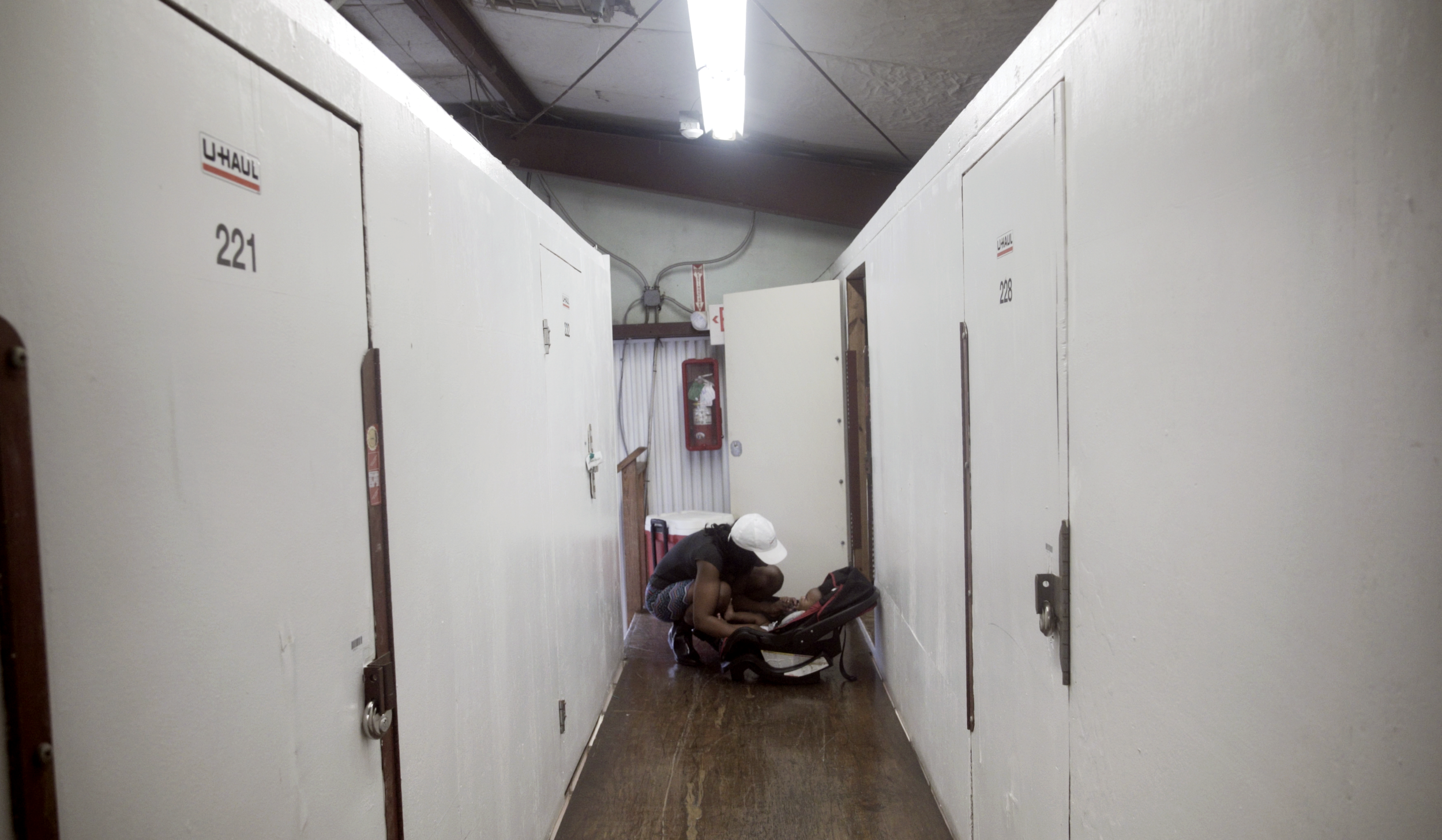
From the beginning of the pandemic, it felt like New Orleanians were in another Hurricane Katrina but slower moving. It was yet another disaster that would disproportionately impact the same population that was hit so hard in 2005. For a brief time after Katrina, it seemed like, as a nation, we were headed towards some sort of racial reckoning, exploring the ways our legacy of slavery has impacted current systems, but that was short lived. In the spring and summer of 2020 folks were told to stay home, their children would be learning remotely. When they listened, many lost their livelihood. New Orleans’ legacy of unequal and substandard housing was being exacerbated by a housing and economic crisis brought on during the pandemic. Local eviction moratoriums were running out and it was clearly an impossible situation. I had done a few shorter stories on evictions during COVID and felt a conviction that if I were really going to tell this story, I needed to follow several families over an extended period of time. I reached out to a friend who is a lawyer for an organization that provides pro-bono legal aid to tenants. Her caseload was beyond anything she had experienced before and she felt we were headed towards a major catastrophe. I told her I was interested in speaking with families facing evictions, and she reached out to several clients to see if they were interested in speaking with me. Both of the women I ended up following had been displaced by Katrina in their youth, and here they were again fifteen years later, thrown into similar chaos by a different disaster.
Reflecting on this project — what were your main learnings? How did this work inform your practice as a photographer and identity?
I learned much more detail about displacement and about the terrible housing policies in New Orleans, which is one of the worst places for tenant rights in the country. One especially shocking learning: the official data on evictions tells only half of the story. The actual number of people who lose their home to eviction procedures is likely at least double the numbers reported. Often, landlords leave unofficial eviction warnings on doors that frighten tenants off or tenants vacate before their eviction hearing occurs. These people are displaced, their lives disrupted regardless of a court ruling. Both of the women I followed never received an official eviction on their record, but they were displaced and their lives thrown into chaos nonetheless. Households headed by Black women have historically experienced the highest rates of eviction. The ripple effect it can have on mental health, jobs, education and many other aspects of their lives is well documented. There have been studies showing COVID spikes in high eviction areas. One recent study concluded that a federal moratorium on evictions placed from early March 2020 through the end of November 2020, may have reduced COVID-19 infections by 14.2% and deaths by 40.7%.
On paper, I knew the ripple effect evictions can cause families and their entire communities. But witnessing it first-hand, I felt tangentially the chaos and stress caused on these women’s lives. I was striving to document their stories safely in a pandemic, during the most active Atlantic hurricane season on record, and in the lead-up to one of an unprecedented presidential election. It was a trying time for me — and I was not facing a fraction of the uncertainty they were up against as they struggled to move forward, seeking housing with children in tow.
Why do you think it’s important to tell women’s stories?
These women opening their lives and telling their stories is speaking truth to power. We live in the most powerful and one of the wealthiest countries in the world, yet many of our systems are wrought with inequity. The lack of protections for tenants in Louisiana sustains racial, gender, economic, social, and political inequality. We are at a crossroads with new legislation and potential for policy change. Do we build back better or fall back to our same, flawed system? We didn’t learn our lesson from Katrina. We built back more segregated, had more displacement and more economic inequality, than before Katrina. I hope and have to believe that witnessing the human impact of a broken system can be a catalyst for change. While folks need immediate assistance in the short term, I hope this film can help us all try to reimagine how we could create real lasting change in this country. If you haven’t experienced housing insecurity, and don’t fully grasp the fallout both personally and how it can impact entire communities, it’s important to connect with these experiences so that with our voices we can hold our policy makers accountable.

This project focuses on the evictions of two Black women in New Orleans. You do such a great job of showing nuance in their situations. What advice would you give to photographers/filmmakers about awareness of and challenging long held stereotypes of marginalized communities?
First off, representation is crucial and should have been a louder part of the conversation in journalism long before 2020. I am a white woman working in a majority Black city, and it’s important that I consistently examine the filter through which I view the world. I feel it is important that all journalists or documentarians study the axes of oppression and intersectionality. I believe it is our duty to understand these concepts. During a fellowship at Syracuse University several years ago, I took a course in social work because I felt it would help better equip me in navigating trauma across communities in my work as a journalist. In that class, I was tasked with researching one aspect of my identity to better understand the lens through which I see the world. That experience and class gave me new tools to examine my own privilege and it gave me a stronger microscope to examine how I navigate my storytelling. I would later incorporate what I learned there into a class I developed and taught on covering trauma at the Rochester Institute of Technology. I feel strongly all journalism schools should incorporate social work in their curriculum, for the sake of those we cover, our communities and for ourselves. This type of self reflection and deep understanding of trauma is crucial, most especially when it comes to covering communities that have been historically exploited.
You work so much in New Orleans. How does a sense of place play into your work?
A couple of years ago when I returned to New Orleans after being away from months, I was riding my bike and I had this feeling of almost euphoria rush over me. I know that sounds a tad silly, but I think in that moment I realized that I love New Orleans very much like I would love a human being. Folks here celebrate life, even in death. The culture is one of connectedness with one another — and to deep tradition, music, dance and food. If you pass someone on the street and fail to acknowledge them in some way or say hello, you are either rude or not from here. I have always loved that spirit of openness and as a journalist it has helped in building connections quickly. It’s important to note that so many of those things that I love about this place are rooted in Black culture. I think a sense of place has no other choice but to play a huge role in the work I produce because of the distinctive nature of New Orleans.
When working in other communities, how do you work to build trust and relationships with locals?
Time spent is the best way. And when that isn’t possible, finding common ground. I believe to do this job well, you must truly care about and want to engage with other human beings. If you aren’t coming from a place of love, openness and respect, you shouldn’t be doing this type of work. Those who are sharing their stories with you are making themselves vulnerable. I believe it’s ok and builds trust for you to do likewise.
How does this current historical moment impact how you view both yourself as a visual storyteller and the work you’re creating?
Given the number of crises our world is facing, it never feels like enough, to be perfectly honest. I think it’s important that journalists prioritize taking care of ourselves mentally and physically, so that we can keep doing the work, while staying focused and intentional.
What has been a specific surprise or challenge of working on this film?
Again, I knew this would be a difficult story. But I don’t think I foresaw the tangential stress I would internalize in the process. I say this knowing that whatever I have felt or experienced pales in comparison to what Dominique and Ronda are still going through.
Pick a scene or two from your film to deconstruct: what was happening when you took the shot? Set the scene, what was going through your head?
Documenting the constable serving the eviction notices to Ronda and her neighbor was by complete chance. I had spent some time with Ronda already, so we had rapport. But earlier that day I had been filming a different interview and just happened to drop by Ronda’s place on my way home. As I drove up I saw the constable walking up to her door. I flew out of my car and caught the end of it and was able to film Ronda’s reaction after receiving the notice. Her emotion and reaction in the aftermath of the notice was one of the more powerful moments of the film, where she touched on every aspect of what she and so many in our country are facing. If I hadn’t already made contact with her and built trust and if I didn’t just decide to drop by that day, this raw moment would have been lost.
Several weeks before my second interview with Dominique, she had left her baby with her 18 year old daughter Jeronique in Alexandria while she tried to find work in Florida cleaning up following one of the hurricanes. She had heard friends had been making good money there, and the thought it would be worth the time away from him to try and build a nest egg. I wanted to film her in Florida or dropping off Ja’Kai, but it didn’t work out. I knew it would be important to speak with her before she went to pick him up, to hear about what she had been through, so I interviewed her a day or so before she left to get him. I followed her up to Alexandria for the reunion where she also sold hot plates to try and make some money. That trip was important on multiple levels — the time away from Ja’Kai seemed to be in vain because the work didn’t pan out, and she was missing her baby. Her emotions in that moment were raw, and the reunion was important. Documenting her trying to make some money selling food was important, as well as meeting and having the perspective of daughter Jeronique added layers to her experience.
What motivates you to keep making pictures/films? In one sentence describe why visual storytelling matters to you
Visual storytelling matters because. . . it’s the best way I know to effect change.