
Introduce yourself: tell us who you are in a few sentences and give us a little background on your career path thus far.
I am Yesica Prado. Strange spelling and easy to forget. You spell it like Yes I can, but without the n. I am a first generation Mexican immigrant from Nezahualcoyótl, Mexico – a former informal settlement adjacent to Mexico city. At nine years old, we left home and I grew up undocumented in a southeast neighborhood in Chicago, Archer Heights. With limited choices for a job without a social security, I ventured into photography to learn a skill, a trade. My hopes were to earn a living as an independent contractor and I attended the University of Illinois at Chicago. But unexpectedly before turning 21, I was granted a U-Visa and years later, I took advantage of this new opportunity to seek a master’s in journalism from the UC Berkeley Graduate School of Journalism. After school, I began freelancing for the San Francisco Public Press as a photojournalist and writer. Today, I’m happy to continue working with this incredible team, documenting housing inequality in the Bay Area through the CatchLight Local fellowship.
Can you tell us about your personal connection with your fellowship work?
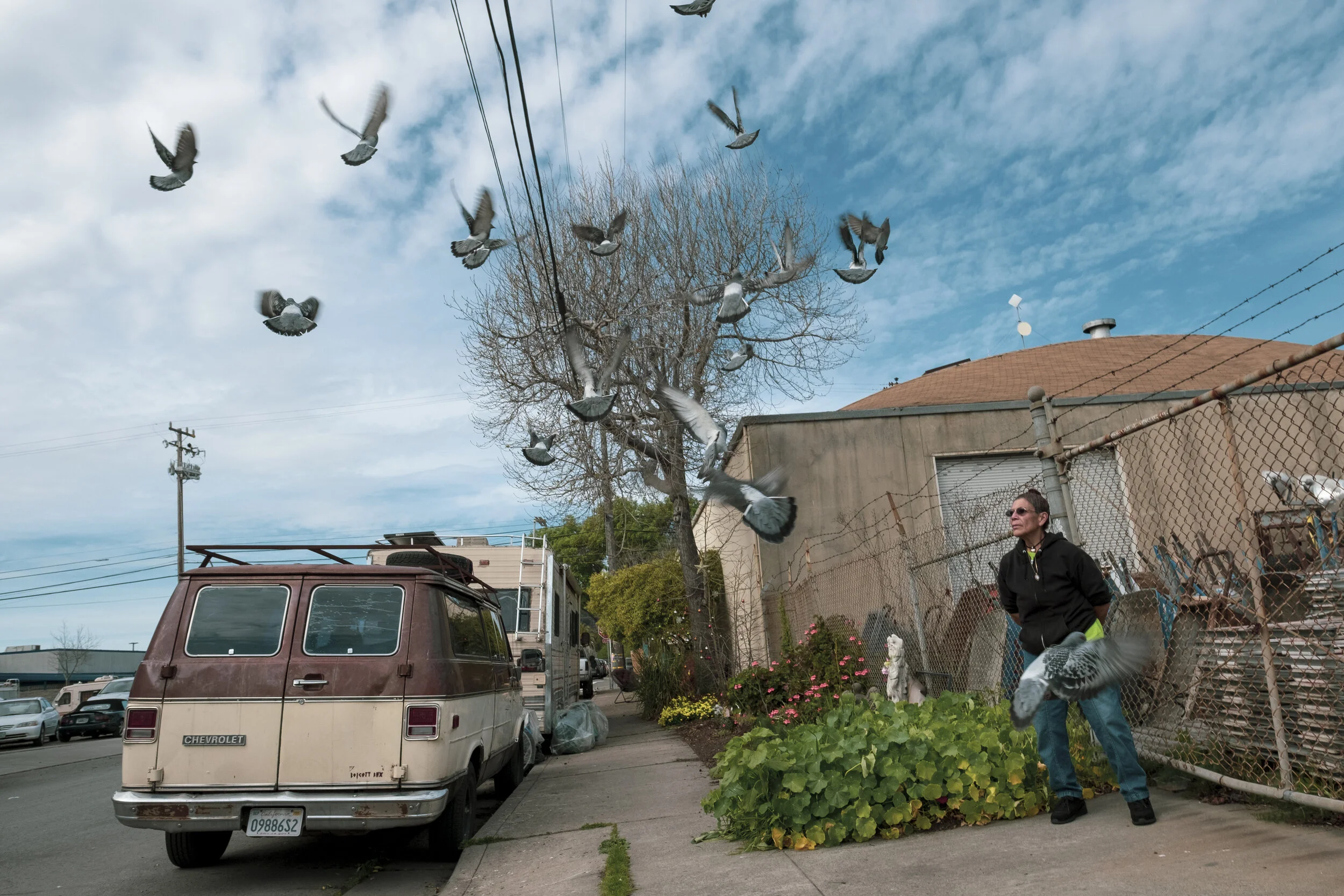
In my fellowship work, I explored the culture of vehicle living in the Bay Area, hoping to shed light on the teamwork and hardships of living on public streets. In my personal experience, I have spent the last three years living on public streets. I didn’t arrive to this situation by choice. After my first semester of graduate school, I lost my housing in San Francisco while studying journalism.
I searched for all kinds of housing options in hopes to stay in school, but affordable options were very scarce. I purchased a recreational vehicle after many failed attempts to stay indoors. But while I purchased a vehicle as a means to stay alive, I was unaware of the great effort it takes to maintain this lifestyle from avoiding the police for citations to finding places to do house chores and homework on the streets. It was difficult. It was painful. I was lost.
But after graduation day, I got a big reality check. I returned to my home to find construction notices at the Marina Boulevard parking lot, asking us to leave or be towed. No alternatives were given. And that’s when it hit me. We are not welcome here. But everyone living on that strip of land had a boiling question: Where do we go?
For years, a question without an answer. It’s unacceptable. As a journalist, I seek to find answers for my community, hoping information can bring light into our darkness.

What do you think the role is of visual journalism in addressing local issues such as the housing crisis in the Bay Area?
In the Bay Area, the housing crisis is not a new problem, but continuing its documentation is crucial to finding a solution. Here, visual journalism can show our readers available housing options and how people find home in their surroundings. Through photography, we can live that experience and be inspired to find other ways to live with one another. But most importantly, we can begin to see real people in our communities and understand their feelings instead of just talking about an issue.
How did this particular project come about? Why were you interested in it?
During our community displacement from the Berkeley Marina, I explored activism as a way to find a more direct path to creating change. I thought speaking directly to people in power would allow negotiations to begin and find a solution that is fair for everyone involved. But after spending a year of endless meetings, workshops, film screenings and protests, the results yielded to city council crafting a legislation that banned overnight parking for recreational vehicles and campers. After many attempts to bridge communication, it just felt like a slap in the face.
But I am not giving up. I will continue to work until we are all heard. This project, it’s an opportunity to raise the volume on the problem and highlight the voices of my neighbors. It’s a record that we exist.

How do you imagine this the issue/community your project explores is currently being affected by this global moment and is the story going to change?
The pandemic has changed our way of life, but especially for those who find shelter and amenities in the public. As the shelter-in-place order closed all non-essential businesses and banned indoor seating, every person living on the street is struggling to find ways to remain connected. No electricity. No potable water. Poor sanitation services. More than before, people are living day to day.
The story has changed. Before, unhoused residents found themselves at odds with finding essential resources to stay alive, and now the pandemic has only made it worse – a desert on the urban grid.
Personally, the pandemic left me without a second job as a Lyft driver. Now, I survive with some freelance work and food deliveries on my bike.
What has been a specific surprise or challenge of working on this project?
The biggest challenge on this project was knowing when to raise the camera. On many occasions, there was a choice to be made: who is present? Myself? The camera? A difficult call to make, but I always chose people over the work that I could have made.
While documenting the Calloway family, in February, we helped them move out of their RV into their new apartment. Everyone was happy. I played hide and seek with the children, finding all kinds of hiding spots in their new home. There was room to finally play. Capturing the children play would have made great photographs, but I would have completely missed the experience. So I chose to play and have fun. I chose to live this moment, which will forever be burned into our memories. None of us will ever forget this day, and that it’s a greater treasure than a tangible photograph.
Pick 2-3 photos from your series to deconstruct: what was happening when you took the shot? Set the scene, what was going through your head?

It was a Sunday afternoon and the children were out playing on the block. They rode their scooters up and down the street, peeking into neighbors’ doors to say hello. One neighbor came out and she had a surprise for them. From her red truck, she pulled out a pink plastic car that they could ride in and play. Often, she scored toys for the kids from digging through the 1-800-JUNK trucks parked on our vicinity at night.
The kids were really happy. Little Frankie pushed his sister up and down the sidewalk. Sometimes, they would fight for a turn and grandma would have to scold them from the RV window. So to keep from fighting, Aaliyah pulled out her chalk and asked me to teach her how to draw a flower. We sat on the concrete sketching away and smudging colors into the rock with our fingers. Soon after, little Frankie joined us and he doodled green lines all over.
We spent the afternoon playing and drawing until their parents returned home from running errands. The chalk drawings stayed on the sidewalk for weeks, serving as a friendly reminder to pedestrians that children also lived here.

Before photographing Tantay Tolbert, I would spend nights inside my RV at the Bay View neighborhood, scouting the area and observing people’s routines. This helped me better understand Tolbert’s way of life by familiarizing myself with the community and undergoing the same stresses to find resources like water and electricity in the neighborhood.
On this photograph, it was an early weekday morning and Tolbert had just received a 72 hour notice asking her to move her recreational vehicle or risk being towed. She was packing up the belongings around her vehicle, making sure it was ready to relocate. Then she yelled out for her partner and told him to get on the move. At first, I thought both vehicles would start and move around the corner. But it came to my surprise to see Tolbert’s vehicle in disrepair and suddenly, it was being pushed by another vehicle out of the curbside. There wasn’t much time to think about a shot, so I followed the action of what was happening in front of me. She made it to her new parking spot, and I became her neighbor for some weeks. She shared her water and electricity with me, and at times, also ask for help to keep an eye on her dogs while away at work.
Can you talk about the differences between Berkeley and San Francisco’s vehicle residents, similarities between the two?
While photographing vehicle residents in Berkeley and San Francisco, I observed a great difference on how people in these communities survived in their every day lives. For instance, while Friends on Wheels and Tantay Tolbert live on industrial neighborhoods in these cities, life is a lot more stressful on industrial San Francisco.
In the Bay View neighborhood, there’s a higher concentration of construction businesses and warehouses, filling the streets with more activity and loud noise. It’s less common to see people congregating or children playing on the sidewalks. Yet, there’s more unhoused residents in this area, which are all competing for the same essential resources.
In West Berkeley, the neighborhood is being gentrified by rising luxury condos, beer gardens, vehicle service shops, grocery stores and art studios. While these services puts us at competition for space with all the people around us, these services have also allowed our informal settlement to survive and remain connected.
Can you tell us about the self documentation work you are doing, and your work in video?
Video is a challenge, but it’s a new skill I hope to improve! I enjoy working with this medium because I can give my sources their own spotlight for their voice. I want people to be heard.
After the shelter-in-place order took effect, I began documenting myself inside my vehicle. A pending question that I wanted to answer was how do you shelter in place without shelter? For our community, the only available option is our vehicle. I wanted to share my life experience inside my vehicle to bridge communication and let our readers know that they are not alone. We are in the struggle together, but we can also make life a little better.

What motivates you to keep making pictures? In one sentence describe why visual storytelling matters to you.
Visual storytelling matters because telling stories that all people from every walk of life can understand is great journalism. Visuals can transcend language barriers, connecting people from all around the world. A powerful medium to unite people’s hearts.
***
This work was produced in collaboration with The San Francisco Public Press as part of Yesica’s CatchLight Local Fellowship and has been published here.
Hear Yesica reflect on her recent work during a segment from The San Francisco Public Press radio show, “Civic.”