
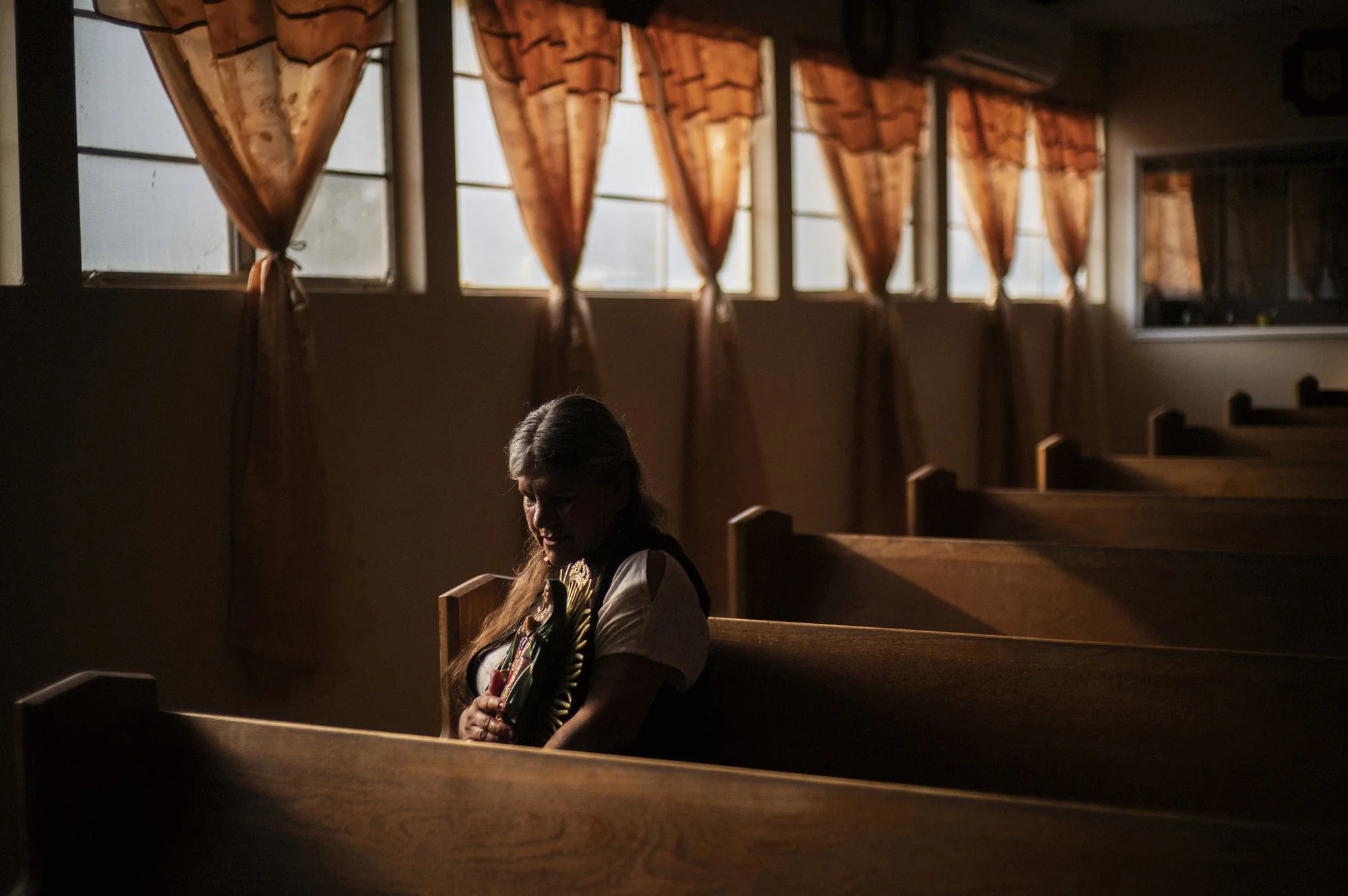

For “The Past is Present,” a visual series by For Freedoms and National Geographic, documentary photographer Brian L. Frank (CatchLight Global Fellow, 2017) returned to the California Central Valley to photograph the everyday realities of farming communities.
In this reporting, Frank visually explores the enduring role of the church in the lives of migrant workers who grow the nation’s food. We caught up with Frank to learn more about the project and his approach to establishing trust with the communities he documents.
This interview has been edited for length and clarity. Click/tap to enlarge images and read captions.
What was the origin of this story and how did you get involved?
Labor is an ongoing theme in all of my work over the past 15 years. I was raised in a very strongly union and civil-servant household and also a household that has deep roots in Bolivarian theory and revolution in Latin America, so in many ways, much of my work has been a manifestation of me seeking to learn and share more on these themes.
This work is a continuation of “East of Eden,” a project I’ve been developing for many years. I could probably trace its roots to my work on the Colorado River along the US-Mexico border.

To create this work, I saturated my mind with the general tone of FSA (Farm Security Administration) photographs. I also read a lot of Steinbeck for inspiration—to tap into my emotions around the themes of labor, history, exploitation and water in the American Southwest and Mexico.
My goal was to make timeless images that help build a throughline in viewers’ minds between their unconscious racial memory of Dust Bowl farming migrants, or “Okies,” and present-day agricultural workers, who generally migrated to the U.S. from Mexico or Central America or are descendants of those migrants.

This latest chapter examines how faith takes on even more importance for folks who for various reasons felt forced to leave their homelands. This came into especially sharp focus when I was documenting stories in the Valley during the COVID-19 pandemic.
I saw firsthand how the very people who feed our country are also systematically unable to rely on our government for any assistance. Indeed, they are actively pursued by a government that seeks to deport them.
During the pandemic, faith played an incredibly important role in their lives, because Latino migrant workers were dying at elevated rates, and their families leaned on the church for strength. But faith institutions also took on a very practical role for these workers, providing for other needs like childcare.
I wanted this work to speak to the hypocrisy of scapegoating immigrants—essential workers in this case—but I also hoped to create a bridge between migrant workers and others who may be influenced by that harmful rhetoric, who are quite often also people of faith.

You photographed people in very personal contexts — at home, at work, at worship. How do you go about establishing that connection with so many individuals and groups of individuals to ensure they feel safe and willing to appear in your work?
There are many important factors to consider, but for me it comes down to two things:
First, I look for how people in the community wish to be represented—I ask them questions and collaborate with them to make sure I achieve that visually. I think this can be a controversial topic in journalism, unfortunately. There’s a long history of journalists being taught to extract rather than collaborate. I think this is at the core of many of the problems we see with media representation today.
I also extend this courtesy to people I may not agree with politically, which gets to the second part of my approach, which is to not always assume I’m right. Instead, I engage under the assumption that I’m wrong and do my best to just be open to different worldviews. Even someone I disagree with can get comfortable with me if they know I’ll communicate their points of view in an honest way.
I care deeply about people and there’s no faking that. I try to connect on an emotional level, and I think the people I work with realize that. I sometimes feel like I can only really be myself with participants in my stories, because I have to be vulnerable in ways I’m not always comfortable with in my everyday life. That’s what it takes to put people at ease in these intimate moments I document with my camera.

What guidance do you have for other photographers who are documenting migrant workers or, for that matter, anyone from a historically marginalized or underserved community?
Consider your motivations for creating the work, be honest with yourself about those motivations, and be willing to share your feelings and motivations with your participants.
If you can’t answer that question truthfully, then you should reconsider and maybe find a different topic that you can approach authentically. Without those feelings inside you, you can’t create emotionally engaging work.
Look for guidance in works that inspire you, that make you feel deeply. Find what allows you to connect with your own emotions before trying to visually communicate anyone else’s.

Brian L. Frank is a San Francisco native who works on photo documentary projects across the Americas. His visual stories and reporting explore themes of cultural identity, social inequality, violence, workers rights and the environment.
Website: www.brianfrankphoto.com
Instagram: @brianlfrank