
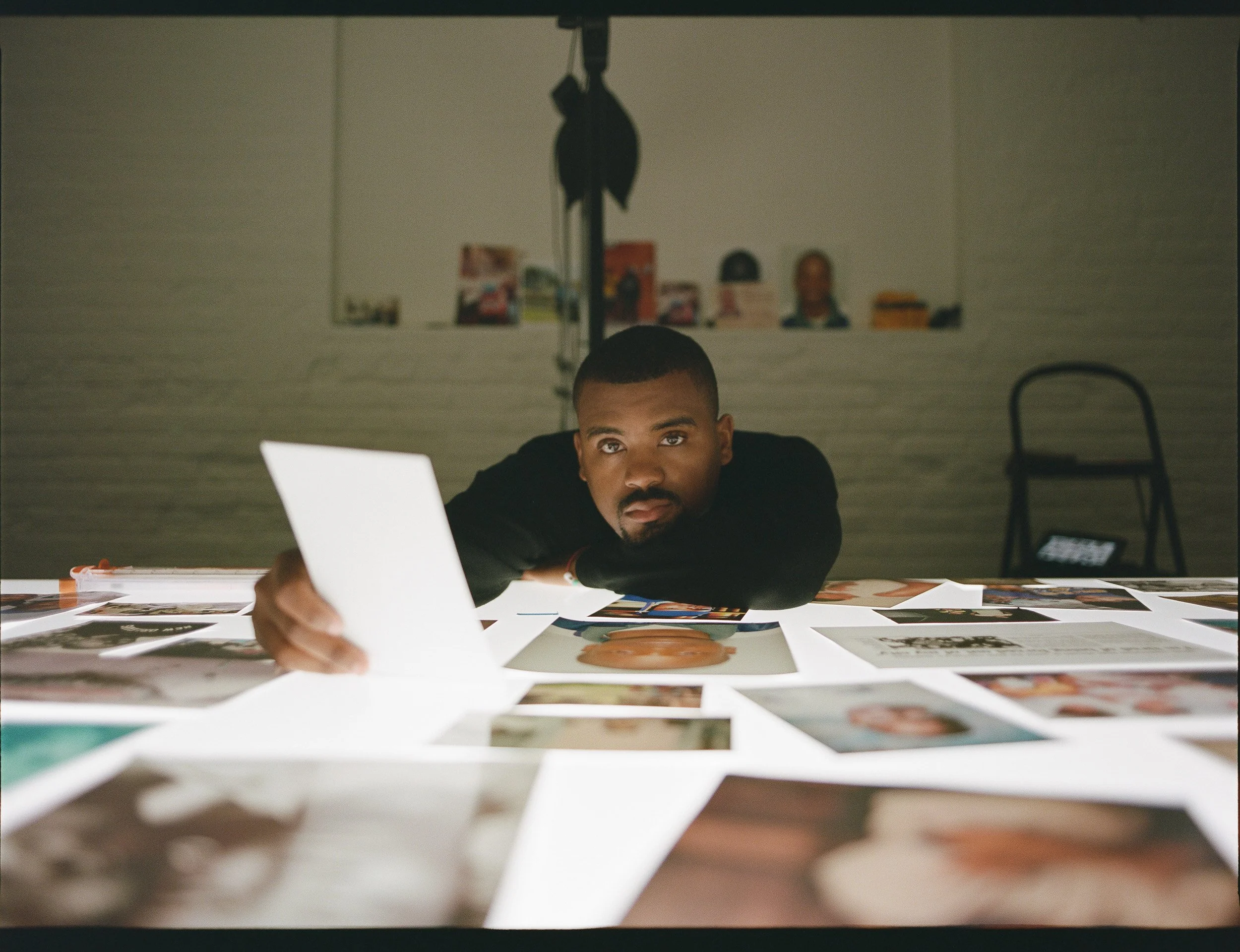
When Edward Buckles Jr. was just barely a teenager, he experienced what would one day inspire him to become a visual storyteller. The award-winning director of the documentary film, “Katrina Babies” (HBO, 2022) sat with us to discuss his creative practice ahead of his appearance at the New Orleans edition of the Night of Photojournalism, a touring event that combines large-scale projected photography with first-person storytelling and live music.

The word “Buck” appeared in large white letters on the computer screen as our guest joined the video call. The camera on the other end activated to reveal Edward Buckles Jr., the sun glinting off of his glasses as he paced across a front porch in New Orleans, greeting a neighbor with warm familiarity. “Sorry, I walk around when I talk. I hope that’s okay,” he said as he considered the first question: How does he think about his role as a filmmaker and photographer—and what parallels might a roomful of journalists find in his work?
“When I first came into this game, I didn’t really view my work as journalism. That wasn’t the intention. But I later realized that I was heavily inspired by good journalists. There is power in good journalism,” Buckles said. “But in the same way that good journalism brought me to make ‘Katrina Babies,’ on the flip side of that, I was also inspired by what I would call bad journalism.”
Buckles interrupted himself to clarify that the “bad journalism” he was referring to is the Katrina coverage now widely understood to be problematic and since labeled an “ethical firestorm,” a “black mark on journalism” and, more pointedly, “a cautionary tale…about racial profiling.” He continued to recount his earliest exposure to the real-world impacts of journalism, 20 years ago in the wake of the storm:
“Looking on TV and seeing your city completely underwater, that’s wild, right? It kind of broke this innocence for me. It uprooted me physically, but also emotionally and mentally. I watched the biggest news outlets kind of falsify the story of Black New Orleans in regards to Hurricane Katrina. At 13 years old, I couldn’t really put a name on it, but I knew something wasn’t right.”
After earning a film degree from Dillard University, a local HBCU in New Orleans, the Katrina coverage that haunted a younger Buckles became tools for reclamation: “When I was making ‘Katrina Babies,’ I sat with thousands of hours of archival footage, some of the same footage that I saw as a 13-year-old. I found myself trying to figure out how to reclaim this narrative that was once used to villainize us.”
Black New Orleans is my muse.
— Edward Buckles Jr.
Over the years, Buckles has developed his voice as a champion of Black creative culture, not unlike the first flag who leads the procession in a New Orleans second line. From film to photography, his projects celebrate Black excellence and challenge the stereotypes and visual tropes of Black struggle that shocked him as a teen.
“It’s low-hanging fruit to come down here and pick at the open wounds, to say, ‘Let’s show them at their worst.’ It’s so easy to pick at the trauma,” he said. “But it’s irresponsible to do it if you’re not going to invest and immerse yourself and contextualize it to offer a way forward, to actually get through it.”

Buckles’ admiration for his community is plain to see in his work. Whether in the film “Katrina Babies,” his fantastical productions for publications like Essence and Teen Vogue, or the cinematic portraits in his “We the Culture” series, the native New Orleanian exalts his neighbors, at times elevating them to mythical proportions, casting light on their strength, artistry, leadership, and proud heritage.
“I’m really in love with the people in my community. That sounds really simple, but that’s literally what motivates that work. Black New Orleans is my muse,” Buckles said, reminding me of earlier in our call when he paused to acknowledge a passerby.


Photos by Edward Buckles Jr., Chike Ozah, and J. Alejandro Moreno for ESSENCE
Winding down the interview, we asked Buckles to share a tip that other storytellers and journalists can consider and adopt to enrich their work. To this, he told a story about a photojournalist whose influence can be found in all of his work:
“One of my biggest inspirations is Gordon Parks. Parks did this series for Life magazine called ‘Harlem Gang Leader.’ He profiled one of Harlem’s most notorious gangsters, this guy named Red, who was also very young, like, I’m pretty sure he was a teenager. But when Parks first arrived in Harlem, he just sat with them. He hung out with them. He watched how they moved. He watched what they ate. He went into their homes. And he did this for I don’t know how long, but one day they were sitting on a stoop, and Red asked him, ‘When are you gonna start taking pictures?’
“Gordon Parks was so obsessed with learning about this world and this community, because he’s going to be sharing their story with the masses, right? He was so interested in learning that he had to be reminded by the subject to pull out his camera. That’s a piece of advice that I would give. Learn as much as you can through research, but also in real time. Do that work. Don’t just go in and start taking pictures. Don’t just go in and start writing. Don’t just go in and start filming. Don’t just go in and start projecting, right?”
Buckles takes the stage at the Night of Photojournalism on Thursday, September 11, 2025 at 7 p.m. Tickets are available on Eventbrite. The tour is produced by CatchLight and Dysturb, with support from Enlight Foundation and PhotoWings. The New Orleans edition is hosted in partnership with Verite News and the Online News Association annual conference.